At Canisius University, future physician assistants are challenged to look beyond the diagnosis to recognize how a patient’s experiences and perspectives shape their healthcare needs.
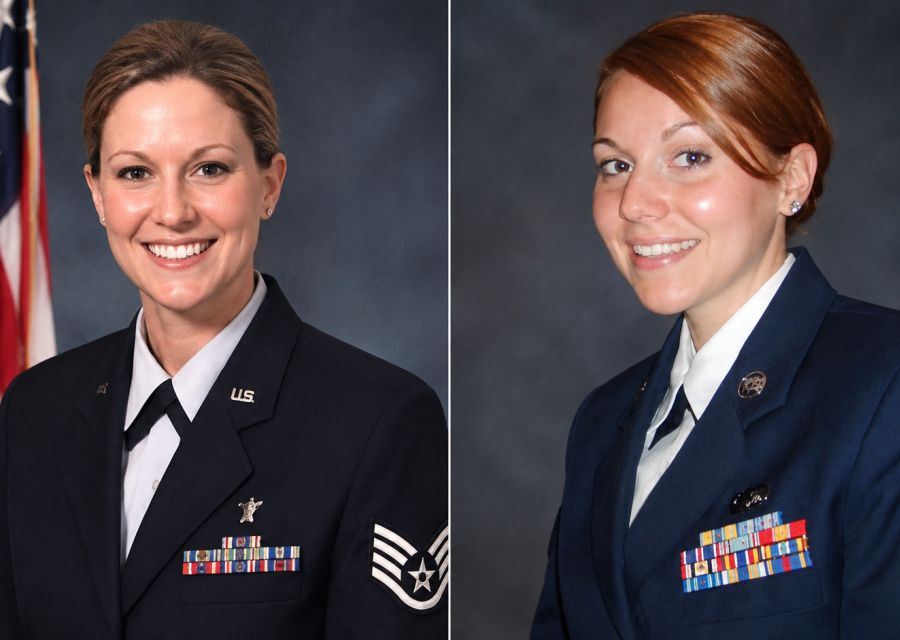
Two U.S. Air Force veterans on Canisius University's Physician Assistant Studies faculty — Aimee Larson, DMSc, PA-C, chair and program director and Christina Scovazzo, clinical assistant professor — draw on their military experience to prepare students for patient care, including the unique needs of veterans.
[Photo left to right: Aimee Larson and Christina Scovazzo]
For Larson, her active-duty service gave her the opportunity to work alongside people from a wide range of backgrounds.
“The military is the ultimate melting pot,” she says. “That exposure teaches you to listen to and understand different perspectives, which is exactly how I approach both my students and my patients.”
She also points to the military's ethos of “service over self” as a principle she hopes students will carry into their personal and professional careers. “As an educator, my goal is to help students translate that selflessness into their daily lives and medical practices,” she says.
Scovazzo echoes Larson's emphasis on service, adding that the Air Force's other core values — “integrity first and excellence in all we do” —guide her work as both an educator and physician assistant.
For Scovazzo, those values are reflected in how she teaches students to interact with patients. “It starts with the importance of building trust and being fully present during visits. I encourage them to look up from their notes, engage with the patient and listen closely to what they share,” she says.
Understanding veteran healthcare
Future PAs will care for veterans in a variety of clinical settings, but Canisius PA students interested in a more focused experience can pursue clinical rotations at Buffalo's VA Medical Center.
Larson describes the significance of that experience in terms of patient care and the university's mission.
“When a student stands before a veteran at the VA, they are confronted with a person who has a vastly different, often intense life story. By learning to listen to the narrative behind the injury or illness, our students also embody the Canisius ideal of being ‘persons for and with others.’”
Placements are offered based on student interest and availability. Students who participate rotate through specialties, like dermatology and emergency medicine, gaining experience caring for veterans whose military service and life experiences may shape their health care needs.
Larson sees this hands-on experience as particularly valuable.
“This rotation fits our university mission because it focuses on an often underserved population,” she says. “The unique life experiences veterans have faced profoundly impact their perceptions of health, providing our students with a powerful, real-world learning environment they cannot get anywhere else.”
Scovazzo adds that caring for veterans requires an awareness by the student of health concerns a vet may be reluctant to discuss, including mental health issues that have gone unrecognized. She encourages students to take the time to understand each veteran’s individual needs.
“Although health concerns may be directly related to military duties, students must learn to ask thoughtful questions and avoid making assumptions based solely on a patient's veteran status,” she says.
Larson also encourages students to recognize the importance of earning veterans' confidence. “Many of these patients are fiercely independent, highly resistant to asking for help, and require an earned sense of trust before they open up,” she says. “A student cannot just be a clinician; they must be a trusted ally.”
For both faculty members, this approach reflects Canisius University's Jesuit tradition of cura personalis, which calls for recognizing and caring for the individual in all aspects of life.
“We are not training students to merely treat symptoms; we are training students to care for the entire human, soul and body,” Larson says.
“Students need to look beyond a diagnosis and consider their physical and mental health, relationships, support systems and experiences during and after military service,” adds Scovazzo.
Ultimately, Larson wants all students to carry an appreciation for each patient's experiences into their professional lives, “but with a special understanding of how that can greatly differ for veterans,” she says.
“I want them to leave the VA with a profound, lasting reverence for the sheer scale of sacrifice these individuals have made. I want our students to understand that military service leaves an indelible imprint on a person's physical and mental well-being, and it is our privilege and duty as healthcare providers to honor that sacrifice with exceptional, compassionate care for the rest of their lives,” she says
About their service
Aimee Larson served on active duty in the U.S. Air Force from 1996 to 2004 as a medic. She was stationed in Texas, Oklahoma and Colorado and deployed to Kuwait for four months in support of Operation Iraqi Freedom, where she worked in an emergency department.
Christina Scovazzo served in the Air Force for 13 years, first as an enlisted information manager and later as a commissioned officer and physician assistant. She was stationed in New Mexico, New York and Texas and deployed to Kuwait in 2005 and Iraq in 2009 in support of Operation Iraqi Freedom