

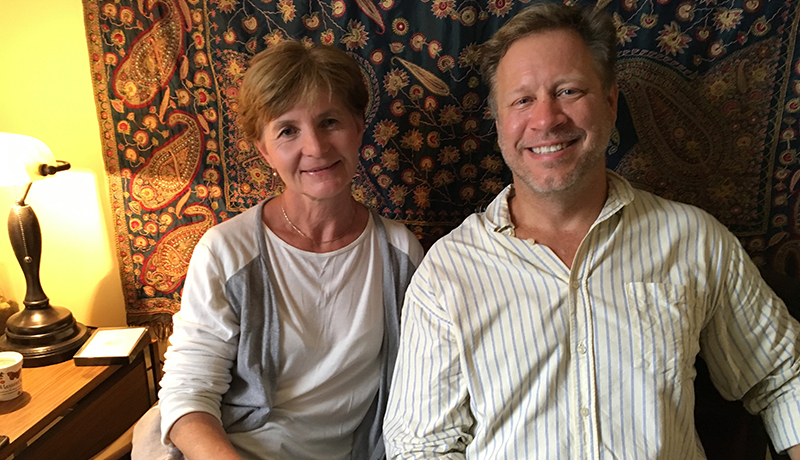
Richard Reitsma, PhD, Chair of the Department of Modern Languages, Literatures, and Cultures, and Professor of Spanish and Latin American Studies, received his M.A. from Purdue University, and his Ph.D. in Comparative Literature from Washington University in St. Louis. His doctoral research focused on issues of gender, sexuality, and race in plantation literature of the American South, Cuba, and Puerto Rico. At Canisius, Richard teaches Spanish, Latin American Studies, Sociology and Honors courses.
Past research and publications include an examination of messages of diversity and tolerance in children’s animated movies, an exploration of the tensions between sexuality and ethnic identity in Latino film, and “Lethal Latin Lovers: Sex and Death in Latin American Cinema,” and “Sexuality, Masculinity, and the State in Cuba, Puerto Rico, and the Dominican Republic.”
He researches gender and minority representation in literature and film of the Latine diaspora, and Latin America. He also works on issues of immigration and is the founder and director of an interdisciplinary series of films, artwork, speakers, workshops, research, teaching materials, and community outreach through[ANON1] the Borders & Migrations Initiative at Canisius. Recent publications include “A Queer Romance, Queering the National Romance: LatinX Narratives of Belonging from The Squatter and the Don to Red, White, and Royal Blue” for the Polish Journal for American Studies and another recent article on the LGBTQ movement in Santa Clara, Cuba as a model for intersectionality in the face of crisis in an anthology of queer theory published in Mexico. Forthcoming articles include “We Carry the Border with Us: Queer Immigration, Border Crossings, and Culinary Identity in I Carry You with Me” (in the Polish journal Lublin Studies in Modern Languages and Literature) and The Empathy Machine of Julio Anta’s Frontera: A YA Graphic Novel of the Border (in the Spanish journal Camino Real).
Dr. Reitsma was also featured on the Pedagogy Primer Podcast to talk about how borders, migration, and Jesuit pedagogy can impact learning experiences in and out of the classroom.
Listen to Dr. Reitsma Discuss Diversity on the Magis Podcast
Margaret Stefanski, Professor of Spanish, received her M.A. degree in Spanish Philology from the University of Warsaw, Poland and her Ph.D. from SUNY at Buffalo. Her research focuses on Spanish Peninsular Literature, interdisciplinary connections between verbal and visual arts, and pedagogy of teaching languages. Currently, Dr. Stefanski writes and presents on Spanish, Hispanic, and Polish short-short fiction or microfiction, which enables her to integrate several aspects of the high/low postmodern culture in her research and teachings. She is also founder and organizer of the annual Polish Film Showcase, under the auspices of the Permanent Chair of Polish Culture at Canisius University. Latest international publications include “Los freaks del circo: convergencias de espacio y forma entre la fotografía de DianeArbus y el microrrelato de Ana María Shua.” Microtextualidades: Revista Internacional de microrrelato y minificción, 2019; “Entre invención y descubrimiento: la minificción polaca de Mrożek y Stachura.”Minificción y nanofilología: latitudes de la hiperbrevedad, Iberoamericana-Vervuert, 2018; “La vida es circo: estética y estrategias narrativas en Fenómenos de Circo de Ana María Shua.”Un universo que se expande: Los nuevos mundos de la minificción. Universidad de la Laguna, 2017; “La minificción y el arte urbano: hacia un encuentro entre genéros”Description: UniDiversidadPuebla: Benemérita Universidad Autónoma de Puebla, 2015; “La minificción y el realismo socialista en la obra de Sławomir Mrożek”. La minificción en el siglo XXI: aproximaciones teóricas. Bogotá D.C.: Universidad Nacional de Colombia. 2014.
Dr. Stefanski also organizes and leads the Short Term Study Tour on Roman-Arab Spain and El Camino de Santiago. She also directs the Study Abroad in Puerto Rico and Andalusia.