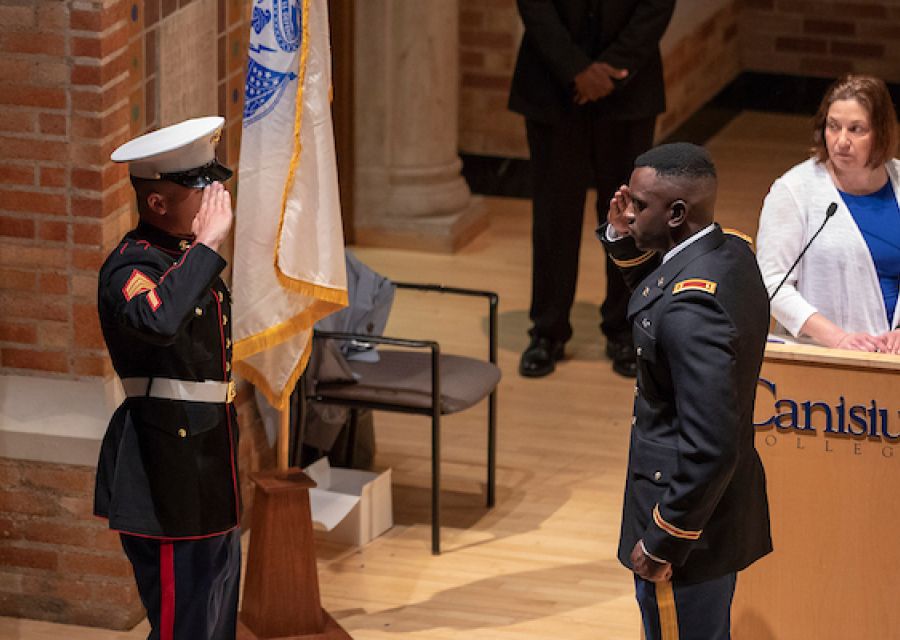
At Canisius University, leadership development goes beyond the classroom. Through the Golden Griffin Battalion Reserve Officer Training Corps (ROTC), students from across Western New York come together to prepare for service as commissioned officers in the United States Army while earning their college degrees.
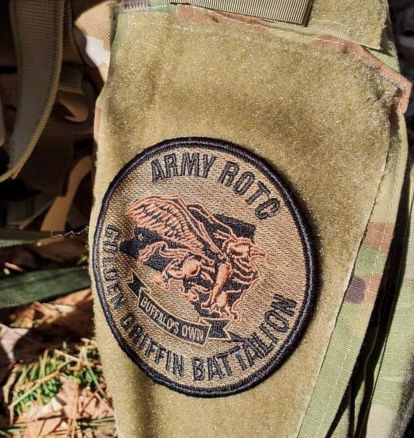
Led by LTC Michael Baddley, MPA, CEM, PMP, the Canisius University ROTC program is the only Army ROTC program in Western New York, serving as the host battalion for cadets from institutions spanning from Niagara Falls, NY, to Bradford, PA. Participating schools include Canisius University, University at Buffalo (UB), SUNY Buffalo State University, D’Youville University, Erie Community College, Houghton University and the University of Pittsburgh at Bradford. In 2025, St. Bonaventure University joined as an extension school and this year, Niagara University is scheduled to join, further expanding the program’s regional reach.
A Proud ROTC Legacy at Canisius University
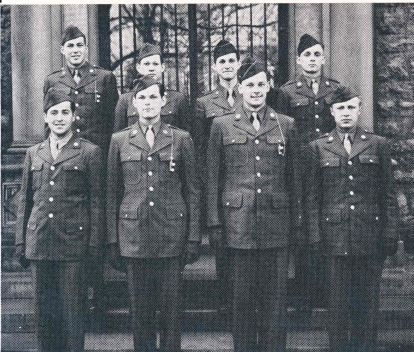
The U.S. Army established ROTC through the National Defense Act of 1916, creating a structured pathway for colleges and universities to develop future officers. Canisius University has an ROTC tradition that dates to at least 1918. Today, that legacy continues through a modern and flexible program.
“ROTC is rooted in the Army’s values—loyalty, duty, respect, selfless service, honor, integrity and personal courage,” says Baddley. “What makes our program at a Jesuit college unique is how naturally those values align with cura personalis. We aim to develop the whole person.”
Army ROTC at Canisius University: Leadership Without Immediate Commitment
ROTC at Canisius University prepares students to commission as Second Lieutenants in the U.S. Army, serving on active duty, in the Army National Guard or in the Army Reserves. However, participation begins without obligation.
Students may take ROTC courses for academic credit at no cost, and in most cases, those credits can be applied toward degree requirements. Because ROTC is an elective, first- and second-year students may enroll in courses while majoring in any academic discipline and without making a military commitment.
“Students don’t need to know on day one whether the military is their future,” says Baddley. “We walk with them through the process. Some join for leadership experience; others stay to commission.” This flexibility makes ROTC especially attractive for students seeking to strengthen their academic programs with management, leadership and organizational skills.
A Flexible, Two-Phase ROTC Program
The four-year Army ROTC program consists of two primary components:
• Basic Course (Freshmen & Sophomores): Introduction to leadership, Army values and foundational skills with no service obligation
• Advanced Course (Juniors & Seniors): For students who contract into ROTC and intend to commission upon graduation
Students may contract as early as their sophomore year. While most cadets pursue ROTC alongside a bachelor’s degree, the program also accommodates students earning master’s degrees, though those timelines are more condensed. Applicants for ROTC scholarships must be U.S. citizens, meet academic and physical fitness standards and receive medical clearance.
Scholarships, Stipends and Financial Support
In some cases, ROTC scholarships may be available to contracted cadets and can include tuition or room and board. Contracted cadets are also eligible for a $420 monthly stipend. Additionally, students who simultaneously enlist in the New York Army National Guard may qualify for tuition assistance while remaining eligible to compete for active duty or Army Reserve commissions—they are not locked into Guard service upon graduation.
The best way to explore scholarship and financial options is by speaking directly with the ROTC Recruiting & Scholarship Officer.
From Classroom to Commission: Life as an ROTC Cadet at Canisius University
ROTC cadets balance academics, leadership training and physical conditioning as part of a structured yet manageable schedule.
• Physical Training: At least three mornings per week from 6–7 a.m., allowing students to be ready for classes by 8:30 a.m.
• Classroom Instruction: Leadership theory, military science and professional development
• Field & Advanced Training: Contracted cadets participate in weekend exercises twice 2-3 times per semester and summer leadership training at Fort Knox, KY after their junior year, alongside peer cadets from across the country
Additional opportunities may include Ranger Challenge competitions, Military Schools such as Airborne or Air Assault among others, and attendance at national or international conferences. “Leadership in ROTC isn’t learned from a textbook,” Baddley says. “Cadets get hands-on experience—but we also emphasize reflection and personal growth, which fits perfectly with the Jesuit focus on becoming thoughtful, purpose-driven leaders.”
ROTC Career Pathways: Military and Civilian Careers After Graduation
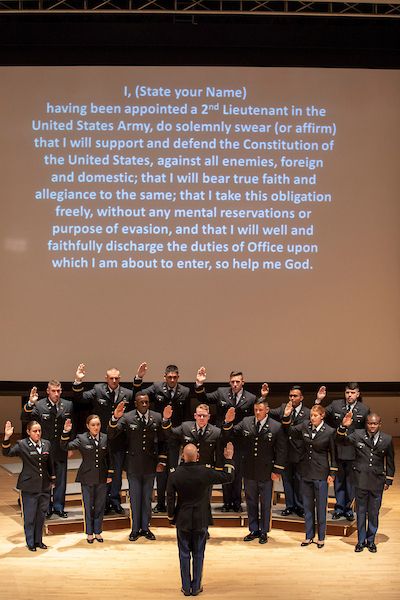
Upon graduation, Canisius ROTC cadets commission as Second Lieutenants and commit to approximately eight years of service, typically split between active duty, National Guard or Reserve service.
The ROTC experience prepares students for careers across a wide range of fields, including:
• Cybersecurity and information assurance
• Engineering and technical leadership
• Logistics and supply chain management
• Medical and health services administration
• Aviation and aerospace careers
• Infantry and combat arms leadership
• Criminal justice and law enforcement
• Legal professions and public service
• Armor and armored operations
• Field artillery and fire support operations
• Finance and financial management
• Adjutant General and human resources leadership
• Military police and security operations
• Signal and communications systems
• Chaplain and religious affairs support
“While many of their civilian peers graduate and start at entry-level positions, our cadets graduate as officers where they are placed in leadership positions of at least 40 Soldiers from day one, with opportunities to impact hundreds or thousands within just a couple years,” says Baddley. “The skills they develop—decision-making, teamwork, self-discipline—translate seamlessly into both military and civilian careers.”
A Community That Extends Beyond Campus
One of the defining strengths of the Golden Griffin Battalion is its multi-institutional structure that brings students together.
Baddley said the sense of belonging, combined with lifelong professional networks, gives ROTC cadets a distinct advantage long after graduation.
“Students in ROTC gain a broader perspective beyond campus—they build friendships across different universities and backgrounds,” Baddley says. “It mirrors the Jesuit call to be ‘men and women for and with others.’”
Student Perspectives: Canisius University Golden Griffin Battalion (Army ROTC)
Cadets in the Canisius University Golden Griffin Battalion come from diverse institutions across Western New York. Here are some of their stories:
Cadet Mark Tasca ’26
Canisius University
“ROTC has helped me build strong time management, public speaking and critical-thinking skills that carry over into every part of my academic and professional life,” says Tasca. “Experiences like field training exercises and Cadet Summer Training pushed me beyond my limits and taught me how to lead others by applying what I’ve learned.”
Tasca, who plans to serve in the New York Army National Guard while pursuing a civilian career, says the organizational and problem-solving skills developed through ROTC translate seamlessly beyond the military.
Second Lieutenant Shay Lippert ’25
University at Buffalo
For Lippert, ROTC became both a professional pathway and a personal anchor throughout college. “My time in ROTC has been some of the greatest moments of my life,” Lippert says. “Through early morning physical training, overnight field exercises and Cadet Summer Training, I learned resilience, empathy and perseverance. The cadre weren’t just instructors—they were mentors who shaped me into a stronger, more driven person.”
Lippert describes Cadet Summer Training at Fort Knox as a defining experience that tested not only technical skills, but character, reinforcing the power of teamwork and service to others.
Cadet Rose Fonfrias ’26
University at Buffalo
Fonfrias joined ROTC to help fund her education and prepare for a career focused on service—but found the experience transformative.
“ROTC has pushed me to strive for excellence and to accomplish things I never thought were possible,” she says. “From completing Airborne School to training in South Korea during my Cadet Troop Leader Time, I learned the importance of accountability, leading by example and mentoring others.” She credits her international training experience with shaping her leadership approach and strengthening her ability to support and develop younger cadets.
Cadet Lily K. Janik ’26, Cadet Battalion Commander
Alfred University
Janik says ROTC challenged her to redefine what she believed she could achieve.
“ROTC taught me that I could do harder things than I ever imagined,” Janik says. “From Air Assault School to leading a merged battalion, every challenge has helped me grow as a leader and as a person. The Army truly allows you to be part of something bigger than yourself.” She notes that the discipline and leadership skills developed through ROTC will continue to guide her,—regardless of where her career leads.
Learn More About Canisius University ROTC
As the only Army ROTC program in Western New York, Canisius University ROTC offers students a unique opportunity to develop leadership skills, earn scholarships and prepare for military or civilian careers—while living out Jesuit values of service and purpose.
Students interested in leadership development, military service or career-building opportunities are encouraged to explore ROTC—whether as a class, an experience or a pathway to commission.
Contact: Erin Morris
Recruiting & Scholarship Officer | 716-888-3239 | 716-365-9171
@email