
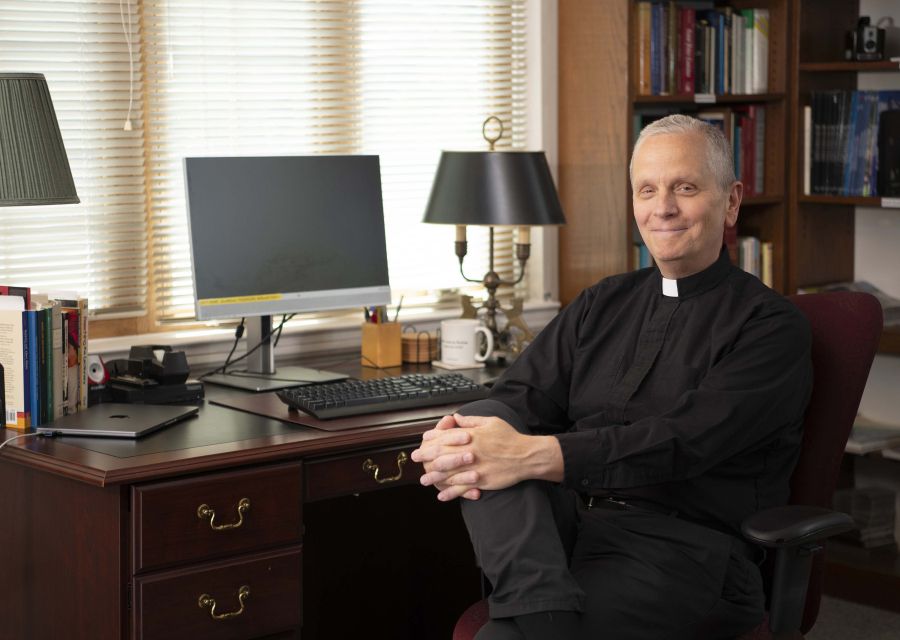
On July 31, the Feast of St. Ignatius Loyola, Rev. Robert E. Reiser, SJ, began his service as provincial of the USA East Province of the Society of Jesus, succeeding Rev. Joseph O’Keefe, SJ.
The appointment places Reiser in one of the Society of Jesus’ most significant leadership roles in the region. Yet long before his years of pastoral and educational leadership, he was a Canisius University student riding the Delaware Avenue bus to campus, walking to class and working part time at Mercy Hospital.
For Canisius University, Reiser’s appointment represents more than a significant alumni achievement. After decades working with students and educators in Jesuit schools, he brings a broad perspective on what students need from their education — and why the Jesuit educational mission remains especially relevant today.
His answer begins with a distinction between education as a transaction and education as transformation. “Education for transformation is what we should be looking at,” Reiser says. “It’s about preparing students not simply for what they will do, but for who they will become.”
Reiser says the ability to continue learning and growing is especially important in a higher education landscape that can sometimes become overly focused on career outcomes. “I understand. People work hard and it's expensive. You don't want to leave college with all this debt and no prospects,” he says. “But education has also become, ‘I give you my money, you give my kid a job.’”
Now more than ever, he notes, a Jesuit education can offer something more enduring. “A Jesuit school will not only get you your first job, but it will also get you your fifth job,” Reiser says.
The difference, he says, is what happens to students along their college journey. “Because of the transformation, you become a person who knows how to be resilient, how to recover from failure, how to move, how to lead your life,” he says. “It's transformation of the spirit and the relationship with something greater than yourself that brings meaning to life.”
He says that formation also extends beyond professional success into daily life. “What does it mean to be a good spouse, a good parent, a member of a community, a member of a faith community?” he asks. “I think that's so important.”
For Reiser, that vision of education is not theoretical. It is rooted in the education he experienced at Canisius and in the students he has spent his career serving.
Discovering a World Beyond Your Own
Reiser credits his Canisius experiences with giving him a broader view of the world and opportunities that challenged him — something he believes remains an important part of Jesuit education today.
“I had to leave my comfort zone to come to Canisius. It brought together people from different places. I really appreciated the diverse nature that Canisius had and still has,” he says.
“In addition, learning how to think critically, particularly through the lens of the Church and the lens of the Gospel, was a really important part of my internal formation,” he says.
That formation extended throughout the curriculum, not just in traditionally religious courses. “In our business classes, it was, ‘What does it mean to be an ethical person?’” he says. “In sociology, I had Dr. Jesse (Edward Nash Jr.), a leader of the African American community who really challenged us to look at our world through the lens of the Gospel for things like racial justice and equality.”
He adds, “Those opportunities to encounter new people, ideas and perspectives are just as important for students today.”
Putting the Human Person at the Center of Education
That emphasis takes on added importance as today’s students navigate a world increasingly shaped by artificial intelligence, social media and rapid technological change.
Reiser sees technology as a powerful tool but insists that the human person must remain at the center. “I’m a big AI person, but it has to be used by the human person, not the human person used by it,” he says.
For Reiser, that emphasis is deeply connected to the Catholic and Jesuit tradition. It is also an area where he sees particular strength in smaller institutions such as Canisius.
“I think a place like Canisius really does well with that and has the potential to do even better because it's small and mission-focused on the individual human person,” he says. “It's about enhancing and enriching encounter, belonging, dialogue and inclusion.”
That individualized approach extends to students’ academic and professional development. “You're able to be advised purposely as an individual on a career path,” he says. “A smaller place has so many more resources that are individuated. I think that's very, very important in the life of a school.”
For Reiser, a sense of connection also creates the foundation for students to develop confidence and self-advocacy. “Especially if you feel as though you belong and it's a safe place, it's a community, you can then advocate,” he says.
He says those skills can be difficult to develop in an increasingly mediated world, where young people may have fewer opportunities to navigate disagreements, solve problems and recover from failure on their own. But those experiences matter. “You learn how to recover from failure,” Reiser says.
A Prophetic Mission
As he looks toward the future of Jesuit education, Reiser believes its mission has particular relevance in today’s world. “I think the mission is prophetic in a depersonalized age, in a polarized age, in a transactional age,” he says.
Reiser sees cura personalis, the Ignatian tradition of care for the whole person, as central to that mission. “And particularly in our context, I think issues of justice, of caring for our common home, of serving the poor, of faith in God — all of that emerges out of that,” he says.
He believes the Catholic intellectual tradition has an important contribution to make to these issues, but also that Jesuit education has to confront the practical challenges facing higher education, including affordability.
“Higher ed is becoming so expensive that we're pricing out huge portions of lower- and middle-income households,” he says. “How do we keep getting the next generation an opportunity to succeed in life?”
He sees that challenge as an invitation to think creatively about the future of higher education — and to look to the strength of the Jesuit network.
“I think one of our most creative responses that we have is a system, a network of higher educational apostolates,” he says. “Are there innovative ways to use that network to address the challenges of finance, demographics and the like? I put a lot of value in the network. It’s exciting,” he adds.
For Reiser, the challenge is not simply to prepare students for the world as it exists today, but to give them the intellectual, personal and spiritual formation to help shape the world they will inherit.
“Their careers may change. Technology will continue to evolve. The challenges they face may not have easy answers,” he says. “An education that teaches students how to think critically, adapt, recover from failure, build meaningful relationships and use their talents in service to others can continue to serve them long after they leave campus.”
The ideas that shaped Reiser as a Canisius student continue to inform his understanding of what education can — and should — provide. “I love Canisius,” Reiser says. “It's always my home away from home.”
[Watch a video conversation between Fr. Reiser and his predecessor, Fr. Joe O'Keefe.]
Rev. Reiser’s Career at a Glance
A 1986 Canisius graduate, Rev. Reiser entered the Society of Jesus and was ordained a priest in 1997. He has spent much of his Jesuit career in education and leadership, including serving as president of Saint Peter’s Prep and McQuaid Jesuit, director of vocations for the New York and Maryland Provinces, and director of campus ministry and faculty member at Canisius High School. Since 2021, he has served as executive director of the Jesuit Schools Network of North America and secretary for pre-secondary and secondary education for the Jesuit Conference of Canada and the United States. He began his service as provincial of the USA East Province in July 2026.