
When Meg Greenberg ’26 came back to her Village Townhouse one night and told her roommate Gabi Farris ’26 about a challenge she encountered while conducting animal behavior research, neither student expected their conversation would lead to a nationally recognized research project.
As an animal behavior, ecology, and conservation (ABEC) and psychology major at Canisius, Greenberg had interned at Omaha's Henry Doorly Zoo and Aquarium before working with The Buffalo Zoo, where she spent countless hours cleaning data collected through ZooMonitor, a platform used by zoos to record animal observations. While the software helps researchers collect valuable information, preparing the exported data for analysis is frustrating and time-consuming.
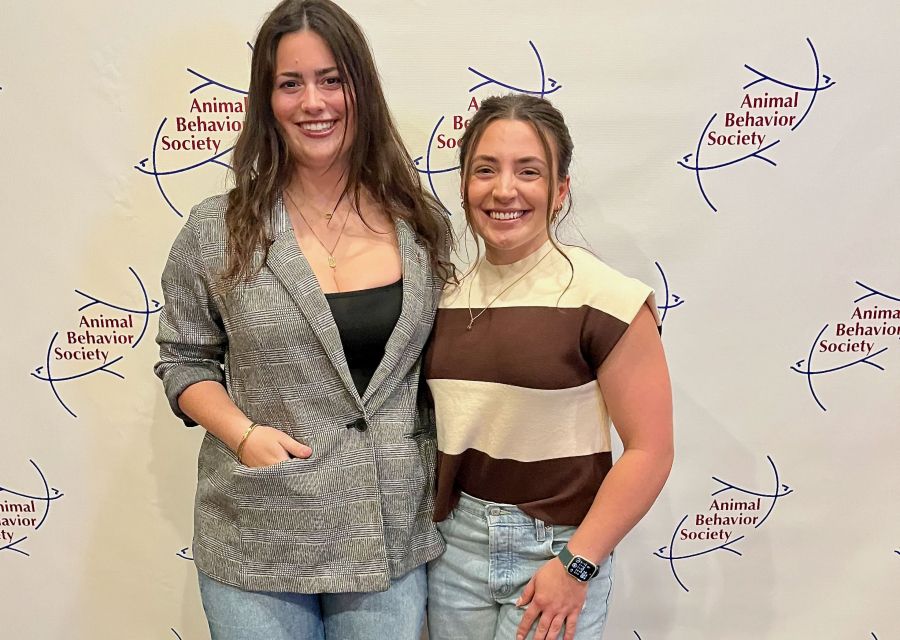
[Photo: Meg Greenberg ’26 (left) and Gabi Farris ’26 developed Megabi, a software application that earned the Genesis Award at the 2026 Animal Behavior Society meeting.]
Through her coursework at Canisius, Greenberg began developing a programming script to automate the process. Sharing the idea with Farris, a data science and computer science major, the pair quickly realized the project had the potential to help researchers far beyond a single zoo.
“We realized this type of data cleaning processing and statistical analysis needs to be accessible to everyone in animal welfare research,” Farris said.
Together, the two students created a software application designed to help researchers more efficiently clean, process and analyze behavioral data. “I loved seeing all the different parts of my Canisius education come together in this project,” Greenberg said.
That interdisciplinary collaboration earned national recognition.
At the recent 2026 Animal Behavior Society meeting in Cincinnati, Greenberg and Farris presented their project, “Megabi: A New Application to Clean and Analyze ZooMonitor Raw Data.”
Their presentation received widespread attention and earned the prestigious Genesis Award, which recognizes the outstanding undergraduate poster presentation at the annual meeting.
During their session, Greenberg and Farris were surrounded by researchers eager to learn more. “Meg and Gabi were so engaging — they did not get a break for two hours because so many people came by to ask questions,” said Jennifer Snekser, PhD, professor and co-chair of the ABEC program. “They were a stand-out among all the research, not just the undergraduate research.”
Farris added, “It was great to see the look of relief and awe on researchers’ faces because the Megabi tool is something that can improve their work by a hefty amount. It gives them time back to do what they do best.”
The award was especially meaningful because Greenberg and Farris developed the project independently rather than as part of a faculty-led research study.
“The most outstanding thing about their work is that it was 100% their own,” said Sue Margulis, PhD, professor and co-chair of ABEC. “Most student posters stem directly from the research of the students’ research mentor; that was not the case for Meg and Gabi.”
For Greenberg, the award was validation that the project could make a meaningful impact. “Gabi and I had planned the presentation as a first look at this project to see people’s reactions,” Greenberg said. “Winning the Genesis Award was huge motivation to keep going. With all the positive feedback, we’re excited to continue developing Megabi and further impact the animal behavior field.”
A Model of Interdisciplinary Learning at Canisius
The success of Megabi highlights the opportunities available to Canisius students to collaborate across disciplines and apply classroom learning to real-world challenges.
Through their coursework, Greenberg and Farris developed complementary skills that allowed them to bring the project to life.
Greenberg credits the ABEC curriculum with giving her the confidence to pursue independent research and solve real-world problems. She pointed to Margulis' Observational Research Methods course, where students develop a research question, submit a proposal to a zoo, collect and analyze data, and present their findings.
“This course taught me the most valuable skills I still use today — independent research, planning and, even more importantly, statistical analysis,” Greenberg said. “It directly impacted Megabi because it was the course that originally taught me how to statistically analyze behavioral data.”
Farris says that Canisius faculty members helped prepare her to take on the challenge of building a tool that could serve researchers outside of traditional technology fields.
“Dr. (Sana) Spektor’s and Dr. (Zach) McGurk’s classes on data mining, data cleaning and econometrics prepared me for handling confusing and overwhelming data using various programming languages in addition to statistical analysis readings and interpretations,” Farris said. “Their emphasis on simplifying accurate statistical findings makes Megabi’s solution digestible for animal people.”
Farris also credits Canisius' software development coursework with teaching her how to build applications around users' needs—an essential skill in developing Megabi.
Greenberg says the collaboration itself became one of the most valuable parts of the experience. “Gabi didn’t know much about behavioral data, and I didn’t know much about coding and data science,” she said. “The information sharing we did throughout the project not only taught me something new but strengthened my own understanding of behavioral research.”
Their experience reflects the type of hands-on, faculty-supported learning that defines Canisius’ University. Students are encouraged to explore connections between disciplines, pursue solutions to real-world problems and use their education to make an impact.
“Meg and Gabi completely made this project their own, worked incredibly hard, and have an amazing product that has now been acknowledged as an important contribution to the field,” Margulis said.
Canisius Continues Its Strong Presence at National Conference
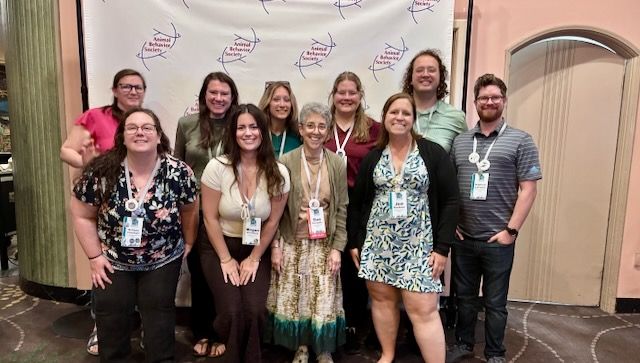
Greenberg and Farris were among nine Canisius alumni who shared research during the five-day meeting in Cincinnati. The group presented talks, posters and participated in the conference’s Outreach Fair, bringing animal behavior research to children at the Cincinnati Museum Center.
According to Margulis, Canisius has developed a strong reputation within the animal behavior research community because students graduate with significant research experience and opportunities to engage with professionals in the field.
“Colleagues know that students coming from our program have an excellent background in animal behavior, have solid research experience, and have had opportunities that may not be available to other undergraduates,” she said.
For prospective students, Greenberg and Farris’ achievement demonstrates how a Canisius education encourages students to explore their interests, collaborate across disciplines and create solutions that make an impact.
“One of Canisius’s strengths is being a smaller institution. The environment encouraged me to collaborate with others across multiple disciplines and pushed me to solve problems outside of my comfort zone,” said Farris.
For both alumnae, the project was only the beginning. Farris says her experience at Canisius strengthened her commitment to using technology to solve problems and serve others.
“Data and technology run the world, and instead of shying away from this, Canisius has given me the skills to take on these challenges headfirst. The experience only strengthened my mission in creating technology with a purpose of serving others,” Farris said.
For Greenberg, the recognition provided motivation to continue expanding the project’s impact. "Winning the Genesis Award was huge motivation to keep going," Greenberg said. "With all the positive feedback, we're excited to continue developing Megabi and further impact the animal behavior field."
Gabi Farris will continue her education this fall at Florida State University, where she will pursue a Master of Science in Biostatistics. She was awarded a graduate assistantship position, which includes a tuition waiver and the opportunity to work as a teacher in the university’s Statistics Department. Farris says her experience in Canisius’ Computer Science and Data Science programs opened more doors after graduation than she ever imagined and prepared her to take on challenges across disciplines.
Meg Greenberg will continue her education this fall at North Carolina State University, where she will pursue a fully funded master's degree in integrative biology in partnership with the North Carolina Zoo. She will serve as both a teaching assistant and research assistant in the highly competitive program, which admits just one student each year. Greenberg said her coursework, research experiences and Buffalo Zoo internships through Canisius prepared her for the opportunity.