
For Aedan McGann ’29, getting involved at Canisius has meant saying yes—even when his first instinct was to hesitate.
A dual major in psychology and philosophy, McGann is involved in a long list of campus organizations, including Little Theatre, Pep Band, Philosophy Club, Psychology Club, Residents’ Hall Association and Unity. Some were obvious choices. Others came about because someone encouraged him to give them a try.
He knew before arriving at Canisius that he wanted to continue theater, having participated throughout high school. Pep Band was different. He initially joined after some encouragement from friends and quickly discovered that he was having “an amazing time.”
“I went there out of peer pressure,” McGann said. “I got more involved as time went on and just enjoyed myself.” That willingness to try something new has become part of his Canisius experience—and has helped him develop as a leader. “I wasn’t incredibly confident in my own abilities,” McGann said. “And being asked to do a lot of the positions I became involved in helped change that.”
McGann’s experience is one of many ways Canisius students find community beyond their classes.
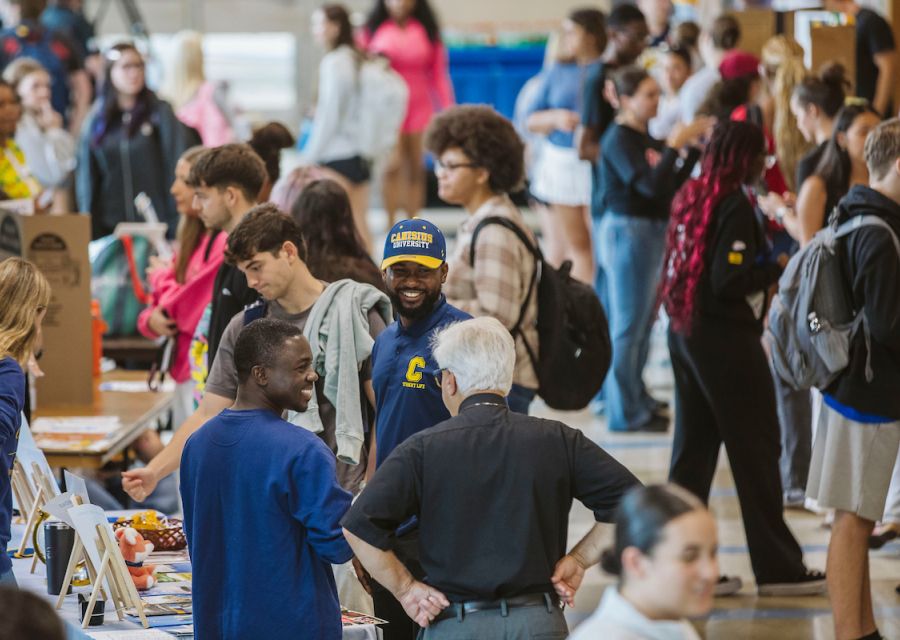
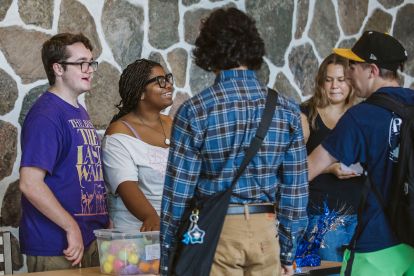
The university hosts the annual Student Involvement Fair (or Club Day) at the start of the fall semester, giving students an opportunity to discover the more than 90 clubs and organizations available across campus.
But finding a place to belong doesn't necessarily happen in one afternoon.
More Than a Club
For Madison Smith ’28, the Canisius Equestrian Team provided a sense of belonging from the beginning.
An adolescent education major with a concentration in English, Smith had been riding and showing horses for eight years when she learned Canisius had an equestrian club. She stopped at the club’s booth during Accepted Students Day—and has been involved ever since. “It helped me fit in when I was a shy freshman. it gave me a purpose,” Smith said.
Her involvement has grown from participant to leader. Now vice president of the team, Smith helps manage lessons and enjoys watching beginners discover riding for themselves. The friendships have become just as important as the horses. “I’ve made friends that I can keep for a lifetime. I’ve had so many amazing experiences,” she said.
That combination—shared interests, shared experiences and the people who come along with them—is at the heart of why student involvement matters, said Eileen Niland, director and counselor of the Canisius Counseling Center. “Getting involved outside of the classroom can enhance your sense of belonging in college,” Niland said. “We feel better, function better and learn better when we feel like we belong.”
In a time when students can be constantly connected through phones and social media while still experiencing loneliness or isolation, Niland said in-person connections can be especially meaningful. “Social connection is fundamental to mental and physical health,” she said. “We are social beings who are wired to connect. All students can benefit from involvement.”
She added that students who feel in the minority somehow, whether it’s how they identify or their life experiences, may especially benefit from connecting with others who identify similarly. “It helps to feel you are not alone,” Niland said.
Clubs and organizations can provide a natural starting point because students are coming together around something they already care about. “Sharing interests and shared experiences are ideal ways to develop friendships,” Niland said. “It’s a great way to ‘find your people.’”
Finding a Place—and Making It Your Own
Sienna Stepien ’29 came to Canisius unsure whether she would find her place. A psychology and sociology major with a minor in criminal justice, Stepien is involved in the Psychology Club, Little Theatre, The Griffin Newspaper, the Philosophy Club and the Residence Hall Association he Residence Hall Association (RHA) helping make campus living “fun, inclusive and unforgettable.”
“I came feeling like I wouldn't ever belong,” she said. “And clubs showed me that there was a place and job for absolutely everyone.” For Stepien, involvement has also meant becoming part of the history of the organizations she joined. She was drawn to hearing about what previous student leaders had accomplished and wanted to help carry those stories forward.
Along the way, she has gained skills that extend beyond any one organization. “I’ve learned how to adapt to changes quickly and efficiently, been able to work with anyone and made memories by messing up and trying again,” Stepien said. “Clubs have shown me ways to use those skills in and outside of the classroom in professional and tactful ways.”
That progression—from showing up to taking on responsibility—is common among students involved on campus, said Michael N. Yates, assistant vice president for Student Affairs and dean of students. “Getting involved gives students another opportunity to feel connected to and belong at Canisius,” Yates said. “We want students to see themselves as whole people.”
Students can participate at whatever level feels right for them. They might attend an event, become a general member or eventually pursue an executive board position. Along the way, they can develop experience in leadership, communication, advocacy, collaboration and service.
And involvement does not have to mean finding the perfect organization immediately. “You don’t have to do everything,” Yates said. “Find something that gives you a reason to stay on campus a little longer, meet somebody new, try something different or contribute to the community.”
Sometimes One “Yes” Leads to The Unexpected
For Thomas Salvatori ’29, that first connection came through music.
Salvatori, a dual major in health and wellness and history, had sung in choirs for years and wanted to continue after high school. His orientation leader heard he was a singer and introduced him to CrescenDON'Ts. The group has given him friends to spend time with between classes, opportunities to perform and reasons to attend events he might otherwise have skipped. “By being a part of CrescenDON'Ts, I’ve gone to events I’m not sure I would have if not for making friends in DON’Ts,” he said.
That ripple effect is one of the less obvious benefits of getting involved. A club meeting can lead to a friendship. A friendship can lead to another event. An event can introduce a student to people or experiences outside their usual circle.
Jason Francey, director of Student Engagement and Leadership Development, said the annual Involvement Fair is a starting point rather than a deadline for making those connections. “Students don’t have to make all those decisions on that one day,” Francey said.
Through GriffConnect, students can continue exploring organizations throughout the year, connect with students who share their interests and learn about upcoming events. Students can also attend many organization events without becoming members, making it possible to try something before making a commitment.
And if students cannot find the organization they are looking for?
“If students look around campus and don’t see what they are hoping to find, we want them to know that they can help create it,” Francey said.
Student Engagement and Leadership Development works with students to establish new organizations, from developing a constitution and finding an adviser to creating an executive board and completing the recognition process.
For McGann, Smith, Stepien and Salvatori, involvement has looked different, but what they have in common is what happened after: they found people, experiences and opportunities that make the university feel more like their own.
For students who are hesitant to take that first step Niland encourages them to consider what they might discover by simply reaching out. “I ask students, ‘What is the worst thing that can happen?’”
At Canisius, there are plenty of opportunities to find out what happens. Sometimes, all it takes is just being willing to try. As Yates put it: “There really isn’t a barrier to exploring.”