
This summer, Canisius University students Savannah Braden '27 and Elizabeth Andrews '29 have watched hesitant readers become confident ones, moments that remind the future educators why they chose to become teachers.
Through a partnership with Say Yes Buffalo, Braden and Andrews are helping young readers strengthen their literacy skills while gaining valuable classroom experience of their own. Funded by Say Yes Buffalo, the six-week summer program places the Canisius students at the Gloria J. Parks Community Center and First Shiloh Baptist Church, where each works one-on-one with elementary-aged students four days a week.
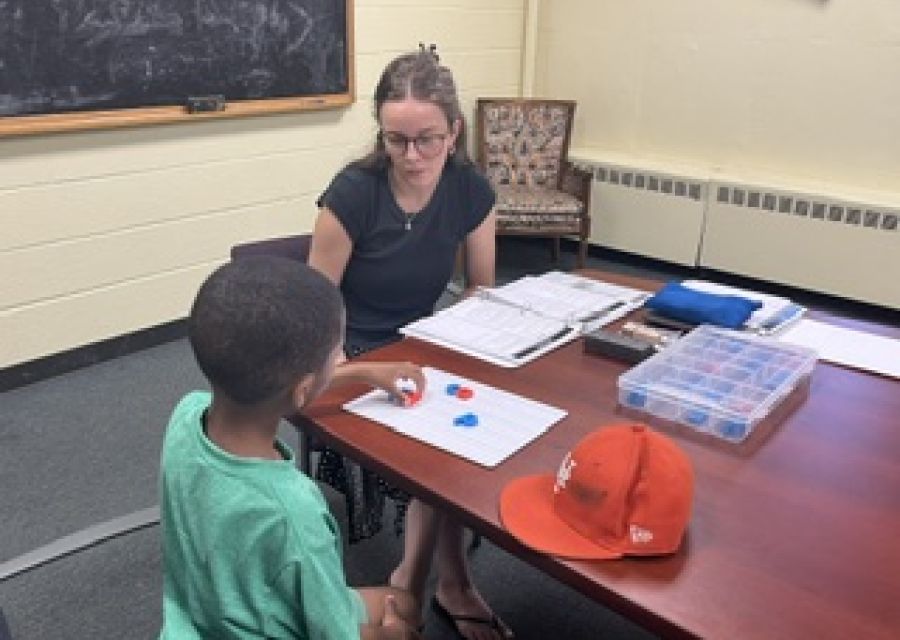
[Photo: Savannah Braden '27, an early childhood/childhood education major at Canisius University, helps a young reader build confidence and strengthen reading skills.]
Using Reading Ready, an early literacy intervention designed to support emergent readers lift off into word reading, the tutors help children build phonemic awareness and spelling skills.
For Braden, an early childhood/childhood education major, the biggest transformations she's witnessed this summer haven't just been in reading ability—they've been in her students' belief in themselves.
“Seeing each of my students become more confident in themselves as readers and as young learners is so rewarding," Braden said. "It’s also inspiring to see my students develop their reading and writing skills over time."
She said the relationships she builds with students are just as meaningful as their academic growth.
"It’s empowering to know that students of all backgrounds can succeed through positive encouragement and consistency," she said. "Throughout the program, my students get more comfortable showcasing their personality, sharing their personal interests and asking questions. One of my favorite aspects is seeing a shy student blossom into a confident and curious learner."
The experience has also shaped the kind of teacher Braden hopes to become. "In addition to increasing my knowledge of phonemic awareness, phonological awareness and effective multimodal learning strategies, the Reading Ready program has strengthened my understanding of how to teach children the foundational skills they need," she said.
Braden said the hands-on instructional techniques used throughout the program have been especially valuable. "I enjoy how the program offers manipulatives such as blocks, chips and magnetic letters to help students practice essential literacy skills," she said. "Those are strategies I know I'll incorporate into my own classroom."
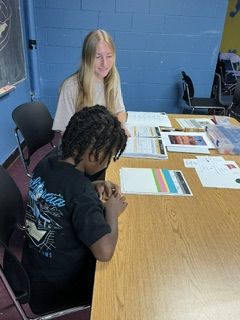
For Andrews, a special education major, the summer has reinforced the importance of meeting every child where they are.
"The most rewarding part has been learning how each student learns," Andrews said. "Every child has different needs, and working individually allows me to understand what challenges them and develop strategies that help them succeed."
She said the experience has confirmed that effective teaching isn't one-size-fits-all. "While some students grasp a topic quickly, others need different supports," Andrews said. "As a future teacher, it is important for me to find what each student needs to succeed."
The one-on-one with emerging readers has also strengthened Andrews' understanding of literacy instruction. “One of the biggest lessons I've learned is how important isolating phonemes and word parts is when teaching students how to read," she said. "Breaking words into smaller parts helps students understand why words sound the way they do. This experience will help me better support students who may struggle with reading."
One of Andrews' favorite experiences has been watching students become excited about reading. "At the end of each lesson, I give each student a sticker for working hard," she says. "Every time I walk into the classroom, the students are excited to come practice reading. Knowing that I'm creating a fun learning environment makes me very hopeful as a future teacher."
According to Elizabeth Turner '04, MSEd '08, director of educational partnerships at Canisius University, programs like this are an essential part of preparing future educators.
"This partnership is especially meaningful because it allows students to gain paid, hands-on teaching experience while helping improve literacy outcomes for children in Buffalo," Turner said. "It's a true win-win for both our students and the community."
Turner says working one-on-one with children helps Canisius students understand that meaningful learning begins with meaningful relationships.
"Our students build social-emotional connections and see firsthand how relationships influence learning," she says. "They quickly realize that student engagement depends as much on feeling seen, safe and supported as it does on the lesson itself. Even the best lesson plan has limited impact if a teacher doesn't understand and respond to students' individual needs."
The Reading Ready program also prepares Canisius students to implement evidence-based literacy instruction from the start of their careers.
"Literacy instruction is undergoing a major shift in P-12 education, making it essential for educator preparation programs to equip future teachers with research-based, evidence-supported practices," Turner says. "At Canisius, students not only learn the principles, but also how to apply them through tutoring, gaining practical experience in effective literacy instruction. As schools continue training current teachers in these approaches, our graduates enter the workforce ready to implement them from day one."
For Turner, the partnership reflects the university's Jesuit mission of combining academic excellence with service.
"This partnership reflects Canisius University's mission to educate the whole person through transformative learning experiences while fostering a lifelong commitment to service," she said. "The more opportunities students have to serve the community while developing professionally, the better they understand their strengths, discover their purpose and prepare to make a meaningful difference throughout their careers."