

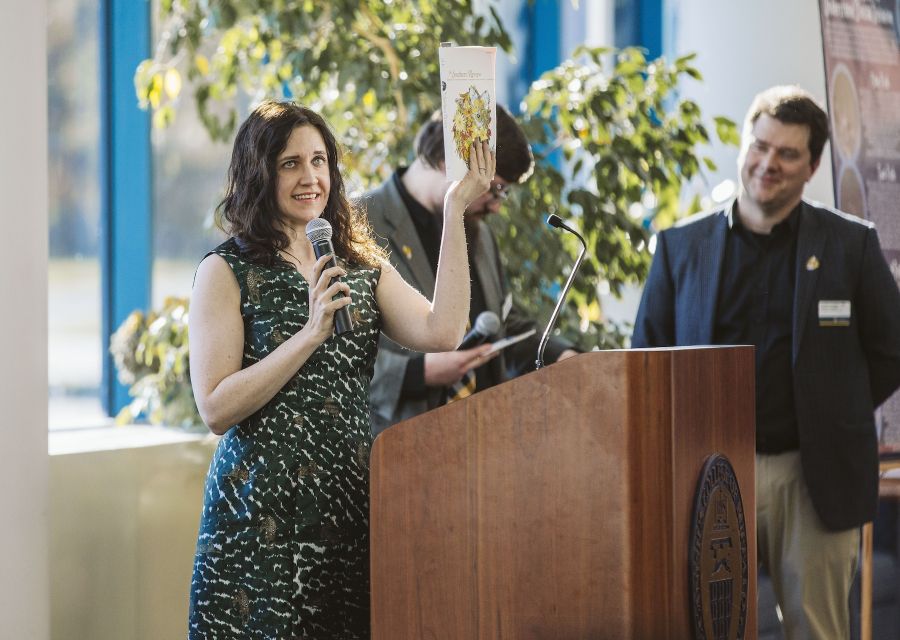
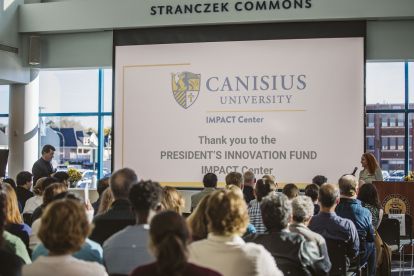
Canisius University faculty shared their research, creative work and scholarly pursuits during the second annual Celebration of Faculty Scholarship on Oct. 21 in Science Hall. The event highlights the range of inquiry taking place across disciplines and its role in enriching the student experience.
Hosted by the IMPACT Center, the event brought together nearly 40 faculty for lightning talks and poster presentations, followed by an open scholarship showcase. The format gave the campus community opportunities to learn about their colleagues’ research, explore topics across academic fields and engage directly with the scholars behind the work.
“The Celebration of Faculty Scholarship creates space for our faculty to share the questions they’re asking, the discoveries they’re making and the ideas shaping their fields of interest,” said Jonathan D. Rodgers, PhD, professor of psychology and co-director of the IMPACT Center. “It also helps build connections across disciplines, opening the door to new conversations and collaborations that can benefit both faculty and students.”
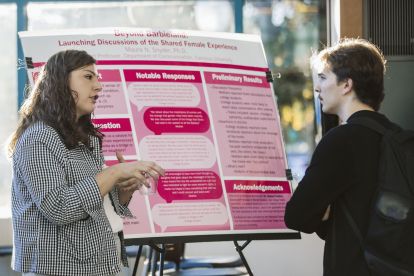
The scholarship presented spanned a wide range of subjects, from the potential restoration of Buffalo’s Scajaquada Creek and the factors influencing artificial intelligence use to student media habits, women’s shared experiences and the science of how protons form from quarks. Lightning talks also highlighted innovative approaches to teaching, including the use of role-playing games to engage students and experiential learning through Canisius’ Digital Zone.
For Jennifer Snekser, PhD, associate professor and co-chair of the Animal Behavior, Ecology, and Conservation Department (ABEC), the celebration offered an opportunity to share her research and learn more about her colleagues’ work.
“We have so many dedicated and talented faculty here at Canisius, and we don’t often get the opportunity to focus on the amazing work that they do beyond the classrooms and meeting rooms,” Snekser said.
She added that the event gives faculty a chance to learn about the questions and discoveries that drive their colleagues’ scholarship. “This celebration reminds us of the vibrant community we have here at Canisius.”
Snekser’s own research focuses on animal behavior and conservation, and she incorporates that work into her teaching. In her ABEC 340: Research Methods in Animal Behavior course, students are collecting data on sex differences in zebrafish social behavior in the lab in Science Hall.
“My students don’t just learn about scientific discoveries; they learn how those discoveries are made, how to critically evaluate evidence, and how to ask meaningful questions of their own,” she said.
That connection between faculty scholarship and student learning is central to the value of research at Canisius. “By actively investigating questions in their fields, faculty bring current methods, evidence and discoveries into their teaching, while creating opportunities for students to participate in the process of inquiry themselves,” added Rodgers.
The IMPACT Center supports research and scholarship across Canisius by providing resources for project development, grant writing, data analysis, coordination and the dissemination of scholarly work.
Snekser hopes attendees left inspired by the range of faculty scholarship and the possibilities for collaboration. “Despite our different disciplines, we share a commitment to discovery, learning, and contributing meaningfully to our students’ time at Canisius and to the world,” she said.


