
A hands-on entomology research project at Canisius University gave an undergraduate student the rare opportunity to publish scientific research—and make an impact on a growing environmental movement in the process.
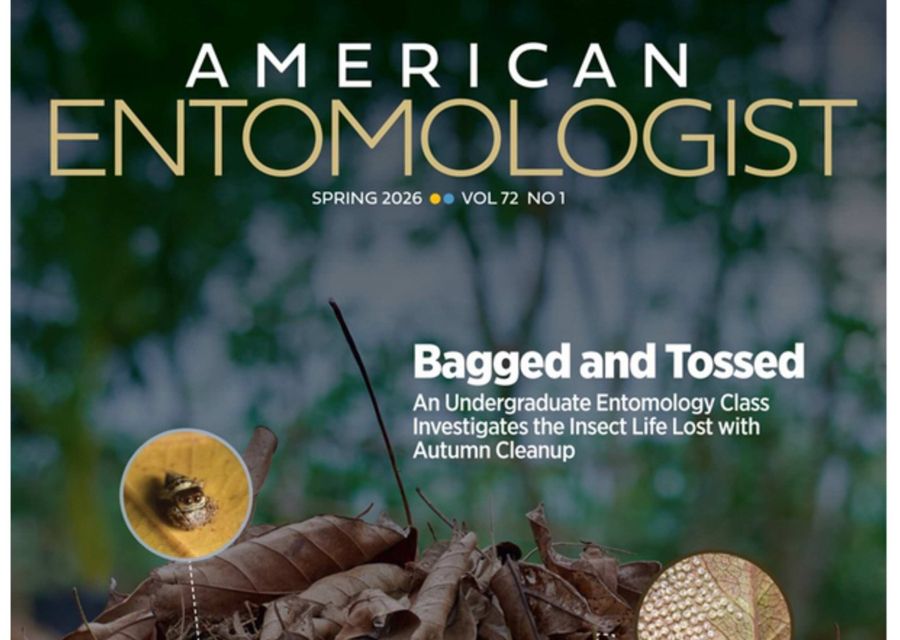
A peer-reviewed article co-authored by Biology Professor Katie S. Costanzo, PhD, and student Peyton A. Callen ’26 was featured on the cover of American Entomologist, one of the field’s leading publications. Even more notably, the research offers some of the first scientific evidence supporting the popular “Leave the Leaves” movement—suggesting that removing fallen leaves from our yards may harm insect populations by eliminating essential habitat.
From Student Researcher to Published Co-Author
For Callen, an animal behavior, ecology and conservation (ABEC) major, the opportunity to contribute to published research marked a defining undergraduate experience. “I could spend hours in the lab, and I gained a huge appreciation for insects. The experience has overall been super fun—except for the hours I’ve lost trying to ID larvae just to call it ‘unknown.’” Callen joked.
Callen assisted with specimen identification and analyzed data collected from the previous year’s class. She began working on the project before enrolling in the entomology course in the spring semester, gaining early exposure to scientific methods, microscopy and insect identification. “I learned to identify many different bugs,” Callen said. “One of the biggest takeaways was realizing how slow research can be. In class, we often just see results, but on a project you get to see the whole process.”
The experience also shifted how Callen views academic work. “Being part of this research shows a lot more of my knowledge and dedication compared to a number grade,” Callen said. A key turning point came when the work moved beyond the classroom. “My first Ignatian Scholarship Day (ISD) poster made it feel real,” Callen said. “That’s when the publishing process started to come together.”
Beyond technical skills, the experience also prepared Callen for future career paths. “Presenting at poster sessions exposed me to the public,” Callen said. “I also experienced pushback when talking about leaving the leaves, which taught me how to advocate for my research.”
From Student Discovery to Published Research
Students from a previous Canisius entomology course described the project as both academically and personally meaningful as they worked on a hands-on research study exploring insect population decline and habitat loss. In the following year, Callen used and analyzed data generated by that class, which contributed to the foundation of the published study.
About the course, Sofia Russo ’25 noted, “I loved the excitement and curiosity that erupted when someone discovered something new.” Alexa Gioia ’25 added, “This project was one of the highlights of my college career. It helped me become more aware of suburban residents’ role in insect conservation.”
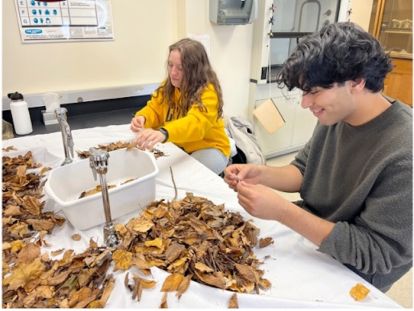
Working in a laboratory setting, students sorted bags of fallen autumn leaves collected from suburban yards across Western New York. Using microscopes and digital identification tools, they spent hours classifying organisms found within leaf litter.
What they found was striking:
• More than 25 insect species across nine orders
• A wide range of arthropods, including spiders, centipedes, sowbugs and ticks
• Insects in multiple life stages, from larvae to adults
• Species representing diverse ecological roles, from decomposers to predators
Students demonstrated strong scientific competency in species identification, data collection, and verification—core components of authentic research practice. The results showed that raking and removing leaves also removes critical insect habitat, disrupting food sources, shelter, and overwintering environments. While exploratory in scale, the study provides early evidence that everyday landscaping decisions can significantly affect insect biodiversity at a time of global insect decline.
The project highlights Canisius University’s commitment to hands-on, experiential learning, where students actively participate in scientific discovery. “The best way to learn is by doing,” said Katie S. Costanzo. “Students applied what they knew about insect anatomy and diversity but also had to problem-solve when encountering unfamiliar species—just like scientists do in the field.”
Because the outcomes were unknown at the start, students and faculty shared the process of discovery in real time. “We were all learning together,” she said. The experience also helped students understand the broader impact of their work. “It was important for students to feel the excitement of discovery firsthand,” Costanzo said. “They gain a deeper appreciation for how scientific knowledge is created.”
Costanzo said the idea for the project was sparked by a gap in existing research around a widely promoted conservation practice. “Many people are familiar with movements like 'No Mow May' and ‘Leave the Leaves,’ but I was surprised to find that no one had really evaluated whether insects are being discarded along with the leaves,” she said. “Once we saw the diversity and abundance of insects, it became clear the results were important to share.”
The project quickly evolved from a classroom exercise into publishable undergraduate research, demonstrating how faculty-led inquiry at Canisius can lead to peer-reviewed scientific literature.
Preparing Students for Scientific and Professional Success
Rooted in the Jesuit principle of cura personalis—care for the whole person—this experience reflects Canisius University’s commitment to developing not only knowledgeable graduates but thoughtful, engaged citizens. The project also advances the university’s strategic plan, Answer the Call, by emphasizing applied learning, undergraduate research and student success through real-world, faculty-led inquiry.
“Experiential learning ensures students graduate with confidence and real-world experience,” said Costanzo. “Whether they pursue careers in conservation or not, they carry this understanding with them and can make informed decisions in their everyday lives.”
As the “Leave the Leaves” movement continues to gain traction, research from Canisius students is helping provide the scientific evidence behind it—proving that small changes at home can have a big impact on ecosystems.