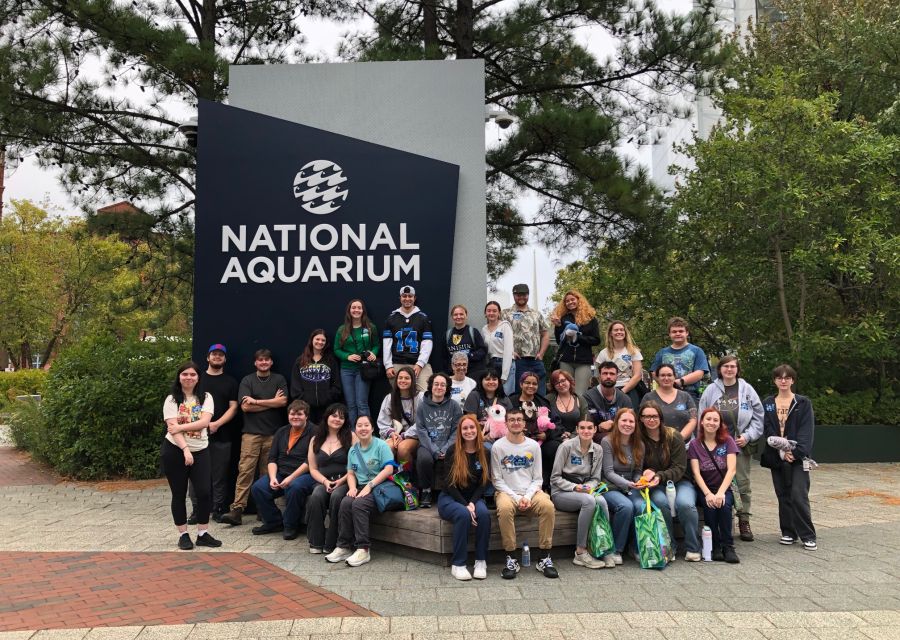
Buffalo, NY — Over fall break (Oct. 11-14), students in Canisius University’s Animal Behavior, Ecology and Conservation (ABEC) program took their learning beyond the classroom, visiting five major zoos and aquariums — the National Zoo in Washington, D.C.; the Maryland Zoo and National Aquarium in Baltimore; and the National Aviary and Pittsburgh Zoo in Pittsburgh — as part of their Zoo Exhibitry course.
“The best way to learn about zoos is to see them—a lot of them,” said Sue Margulis, PhD. “Students can broaden their perspective and think critically about what they’re seeing in ways that can’t happen in the classroom. I can show pictures of a zoo, but seeing and experiencing them in person is hugely different.”
The trip gave students a chance to put classroom concepts into practice. Students were encouraged to think about what makes zoos work and what could be better.
“It was a unique opportunity,” said Abby Gurgol ’26. “Each zoo had its own history and set of circumstances that affected the decision-making. Getting the chance to compare them helps us recognize creative innovations.”
Students were also asked to observe animal behavior along with the exhibit design for their final project which challenges them to reimagine a zoo exhibit based on what they experienced.
Margulis explained the trip is eye-opening for many students. “A big, well-funded zoo has more options than a small zoo. I hope it helps students think about ‘right-sizing’ exhibits for the location and budget a zoo may have.”
Student Neil Chace ’26 found that to be especially true, as he’s been documenting his own zoo visits since 2020.
“I’ve visited 51, and at every one I see something new,” said Chace. “On this trip, I discovered that the National Aviary simulated rainfall in the indoor wetlands aviary enriched the birds’ environment and changed their behavior—something I’d love to see replicated elsewhere.”
During nightly recap sessions the group discussed what they saw.
“It’s interesting that sometimes an exhibit one student considers to be ‘the best’ makes another student’s ‘worst’ list,” said Margulis. “I hope they learn what makes a great exhibit and see that zoos do their best with the resources they have.”
Applying Classroom Lessons into Real-World Zoo Solutions
Margulis noted the trip is an ideal way to show students how different institutions operate. “For instance, the National Aviary keepers routinely interact with the public, while at the National Aquarium most staff are behind the scenes,” said Margulis.
Gurgol said what she experienced reinforced what they learned in class.
“A really effective zoo will make contributions toward conservation and research efforts, even though these might go under-recognized,” she explained. “We purposely looked for evidence of these contributions, whether through reading the signs or talking with the keepers.”
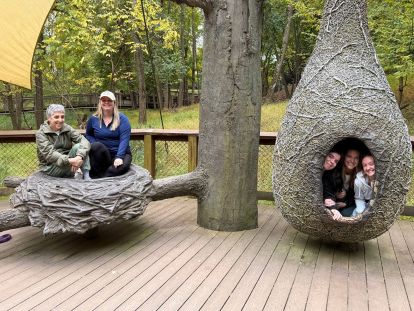
[Pictured at the National Aviary, right to left: Sue Margulis, PhD, with co-leader and Canisius alum Caeley Robinson, BS ’20, MS ’21, and students Angel Suplicki ‘28, Keira Mirc ‘29 and Ashlynn Johnson ’28.]
Since launching the course nearly a decade ago, Margulis has seen students translate what they learn on the trip into impressive final projects.
“One group even created an illustrated children’s book to use as part of a zoo education program,” she said.
Chace noted that comparing the zoos will influence his group’s final exhibit redesign project. “We saw a beaver exhibit at one zoo that wasn’t great, but another zoo had a strong version. We’re hoping to bring those ideas together in our group’s redesign,” he said.
Experiential Learning that Shapes Future Animal Professionals
For many students, the trip offers a deeper understanding of what it takes to care for animals and manage exhibits responsibly.
“Students who want to work in the zoo world need experience if they want to get hired,” said Margulis. “Internships are critical, but another important way is to simply see as much as possible and learn from it. More experience is always better when students start looking for jobs.”
Canisius University’s Animal Behavior, Ecology and Conservation and Anthrozoology programs stand out for their interdisciplinary focus and commitment to hands-on experience.
“Many students have only visited their local zoos, so getting them out of the classroom and into the real world is so important,” said Margulis.
For prospective students who love animals and want to make an impact, the program’s broad, interdisciplinary approach offers exceptional preparation.
“Our program is unique in that it focuses on many diverse areas of animal careers,” said Margulis. “We incorporate natural science, social science and humanities within our faculty. Our connections—locally, nationally and internationally—really help our students succeed.”
She added, “If you’re interested in a zoo career, training dogs, working at an animal shelter, doing fieldwork, pursuing animal law or advocacy—we can help you get there.”
The ABEC program is just one example of the immersive experiences at the heart of a Canisius education, helping students turn their passion into meaningful, career-ready skills while giving them the knowledge, confidence and perspective to thrive in future careers.
Canisius was founded in 1870 in Buffalo, NY, and is one of 27 Jesuit colleges and universities in the U.S. Consistently ranked among the top institutions in the Northeast, Canisius offers undergraduate, graduate and pre-professional programs distinguished by close student-faculty collaboration, mentoring and an emphasis on ethical, purpose-driven leadership.