

Buffalo, NY - A new book co-edited by Canisius University Management Professor Howard R. Stanger, PhD, examines the long-term decline of union membership and collective bargaining in the United States, while highlighting signs of a potential resurgence. “Union Organizing and Collective Bargaining at a Critical Moment: Opportunities for Renewal or Continued Decline,” is the latest volume in a Labor and Employment Relations Association Series. Stanger, whose research focuses on historical and contemporary labor relations in printing, newspapers and digital media, has contributed to three of the series’ annual research volumes on collective bargaining in the United States (2002, 2013 and 2024). He has also published extensively on Buffalo’s Larkin Company, employers’ associations, and other topics related to business and labor history.
“After decades of stagnation, we may be witnessing a pivotal moment for American labor,” said Stanger. “This volume explores both the challenges and opportunities that could define the future of unions and collective bargaining in the U.S.”
According to Stanger, union density peaked at 34.8% of the workforce in 1954 but fell steadily in the decades since. By 2021, only 10.3% of workers were union members, with just 6.1% in the private sector—lower than the rate in 1890.
“Union Organizing and Collective Bargaining at a Critical Moment” analyzes the factors driving the decline, including structural shifts in the economy, employer opposition, weak labor laws and challenges within organized labor itself. Yet contributors to this volume also point to renewed momentum: growing worker activism, especially in sectors like fast food, retail, warehouses, high tech, newspapers and digital media, coupled with a widening “voice gap” between employees’ expectations and their influence at work.
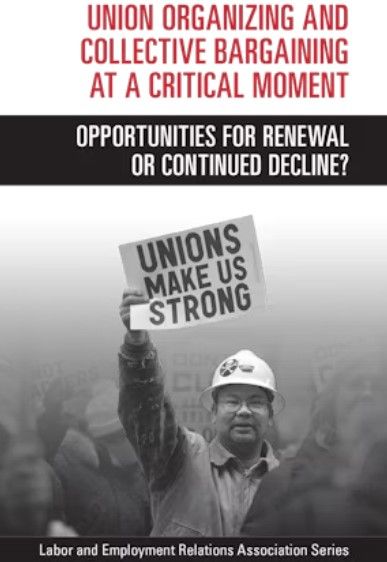
As co-editor for the new volume, Stanger developed its overarching framework and worked with expert contributors to examine different aspects of contemporary labor relations. “Union Organizing and Collective Bargaining at a Critical Moment” was published by Cornell University Press and is available via the Cornell University Press website.
Howard Stanger is a professor of management, which is housed within the Richard J. Wehle School of Business at Canisius University. The Wehle Business School develops career-ready business leaders who are prepared to make ethical business decisions that reflect the interests of multiple stakeholders. In partnership with the Western New York business community, the school emphasizes immersive, experience-based learning that reflects the interconnected and global nature of business today.
Students can choose from six undergraduate programs—accounting, accounting systems & analytics, economics, finance, management and marketing—with national rankings from U.S. News & World Report placing accounting in the top 10% and finance in the top 5% of programs nationwide. At the graduate level, the Wehle School offers the third-largest MBA program in Buffalo and Rochester, according to Buffalo Business First, with three distinct pathways: the flexible MBA, the MBA in professional accounting, and the accelerated One-Year MBA.
Canisius was founded in 1870 in Buffalo, NY, and is one of 27 Jesuit colleges and universities in the U.S. Consistently ranked among the top institutions in the Northeast, Canisius offers undergraduate, graduate and pre-professional programs distinguished by close student-faculty collaboration, mentoring and an emphasis on ethical, purpose-driven leadership.