
Buffalo, NY—Canisius University students are turning curiosity into action—and microphones into meaningful dialogue—through a student-produced podcast, Canisius Conservation Conversations on Spotify.
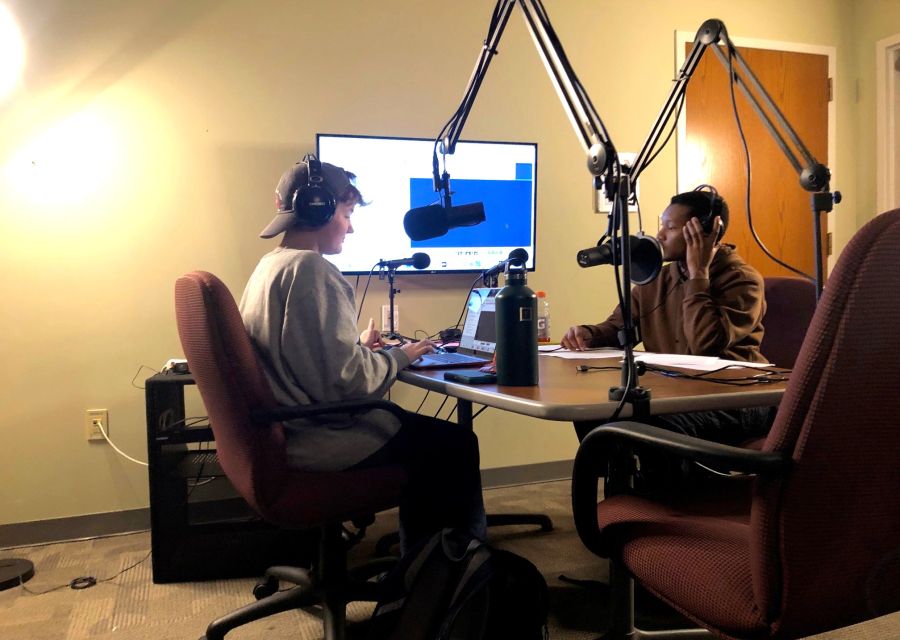
Hosted and produced by students Grace Coloney ’28 and Daunte Briggs ’27 (pictured left to right), the podcast explores conservation issues while showcasing how a Canisius education combines hands-on learning, ethical reflection and real-world impact.
The episode, “What Happened at Ischua Creek?” examined a recent, significant environmental incident in Western New York, offering listeners a clear, fact-based look at conservation challenges close to home.
A Real-World Learning Experience Rooted in Jesuit Education
The podcast grew from the vision of Professor Sue Margulis, PhD, who has long encouraged students to explore conservation issues through experiential learning.
She noted that the podcast had been produced a few times over the years in conjunction with classes but as podcasts have grown in popularity, she wanted to move beyond the classroom to create a more flexible, consistent and sustainable format.
“Digging deeply into a topic and really thinking about the role we play—both in creating the problem and hopefully solving it—is a great learning experience,” said Margulis.
The podcast reflects the university’s commitment to educating the whole person through inquiry, reflection and action—core principles of Jesuit education. “Science communication—especially to non-scientists—is critically important right now. Researching a topic and communicating about it are skills that translate across careers. My hope is that the podcasts can take topics that people might not be sufficiently informed about and make them approachable and understandable,” she said.
Students take ownership of nearly every aspect of production, from research and interviewing to recording and editing—developing practical communication, media and analytical skills that extend far beyond the classroom.
Student Voices Lead the Conversation
For Coloney, an Animal Behavior, Ecology and Conservation major who transferred to Canisius from Ithaca College, the podcast merges creativity with scientific storytelling. “Hosting requires us to put our thoughts into words that are insightful but also understandable,” said Coloney. “Clear communication is important for any career—and even everyday life.”
Coloney notes that the first episode required careful research and a commitment to clarity. “There was so much speculation about Ischua Creek, so we really focused on the facts and worked to make complicated permits and policies understandable for listeners.”
Briggs, a dual major in Animal Behavior, Ecology and Conservation and Anthrozoology, said the podcast allowed him to turn passion into purpose. “I was drawn to the podcast because it gave me the chance to share conservation topics I care about,” Briggs said. “Researching and producing the episode strengthened my ability to clearly present information—skills I’ll use in my future career in behavioral ecology.”
Both students emphasize the creative freedom they were given to shape each episode. “We were given a blank canvas,” Briggs adds. “It’s both challenging and exciting to guide the conversation in a way that is engaging and meaningful.”
Understanding The Event at Ischua Creek
The episode explored the devastating environmental incident at Ischua Creek in Cattaraugus County. According to the New York State Department of Environmental Conservation (DEC), a discharge caused by a catastrophic failure at the Great Lakes Cheese facility resulted in a large fish and wildlife die-off. The DEC issued an enforcement order requiring $475,000 in penalties, operational changes, enhanced water-quality monitoring and corrective actions to prevent future incidents and restore the affected ecosystem.
The students worked carefully to translate complex environmental regulations and investigative findings into an accessible conversation for listeners. “A lot of the information wasn’t yet public, so we closely followed updates and focused on presenting accurate, clear information,” said Briggs.
Learning Beyond the Classroom
Margulis described the first recording as a shared learning experience. “We knew the first podcast would be the hardest, and it took two tries—but Grace and Daunte did a fantastic job,” she said.
Through the process, students gained skills in research, storytelling, media production and science communication— further reinforcing how students translate what they’re learning in the classroom into real-world contexts.
The project was made possible through support from Canisius and the Michael and Christopher M. ’83 and Christine Kelly Endowment Fund, which supports hands-on student learning opportunities.
“I would not have started this effort without the funding,” said Margulis. “To really get students on board, they needed to be compensated for their time. I’m hopeful this initiative continues to grow,” she added.
Looking Ahead: Expanding the Conversation
Through Canisius Conservation Conversations, students are not only studying conservation—they are actively shaping the conversation, demonstrating how a Jesuit education at Canisius prepares graduates to think critically, communicate clearly and act for the greater good.
Margulis hopes the podcast will deepen student learning while connecting with audiences beyond campus. Future episodes will explore a variety of issues, with topics shaped collaboratively by students and faculty.
“Our actions have impacts locally and globally,” she said. “Presenting on a topic is a powerful way to learn—and I hope it encourages students to share their knowledge, expertise and passion.”
Early signs suggest the podcast is already reaching beyond Western New York. After the first episode, Margulis received a message from a student in Colorado suggesting a future topic on light pollution. “How cool is that?” she said.