
Buffalo, NY — For Peyton Koukides ’26, undergraduate research at Canisius University isn’t confined to textbooks or lectures—it’s alive in the field, in front of the public, and swimming just beneath the surface of the Aquarium of Niagara’s Lake Sturgeon touch pool.
This semester, the Animal Behavior, Ecology and Conservation (ABEC) major is leading an independent project on the behaviors of Lake Sturgeon in the Aquarium’s new “Great Lakes 360” expansion dedicated to highlighting the world’s largest freshwater system. Her research focuses on the spatial distribution of the fish—their depth and location in relation to crowd size and time of day—while also considering animal welfare and conservation education outcomes for visitors.
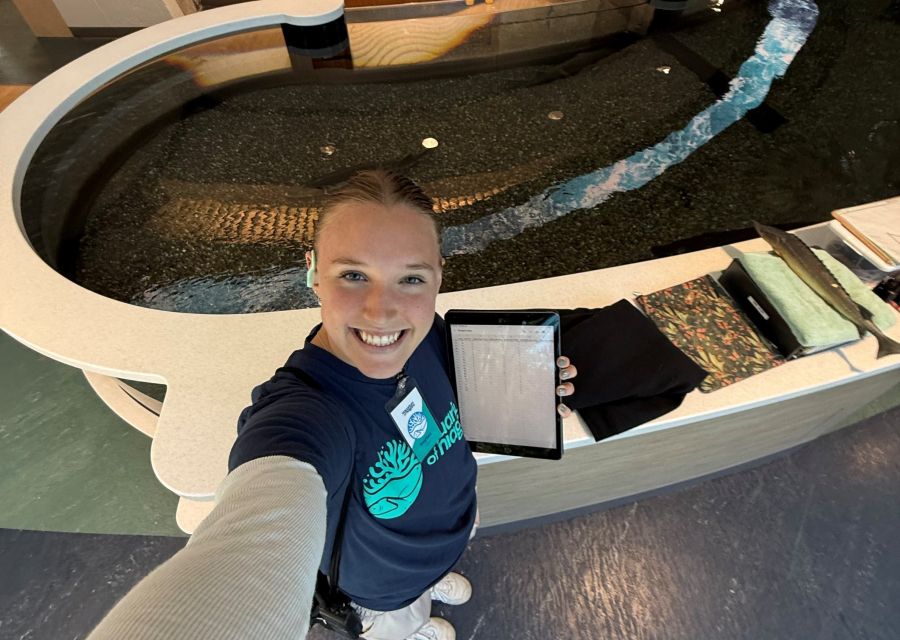
[Photo: Peyton Koukides ’26 takes a selfie in front of the Aquarium of Niagara’s Lake Sturgeon touch pool.]
With minors in anthrozoology and education, Peyton hopes to build a career as an informal conservation educator. “By observing sturgeon behavior and analyzing what drives it, I’m applying principles from my major. At the same time, I am considering whether the touch pool exhibit is achieving educational goals,” she explains.
A typical day in the field means setting up her iPad and collecting data every minute for half an hour, a process that requires patience and precision. Yet Peyton says the biggest lessons have come not just from the sturgeon but from people. “I’ve learned so much from interacting with aquarium staff and educators. Research isn’t just observation—it’s asking questions, listening, and noticing details you might not have considered before.”
Faculty Mentorship Shapes Undergraduate Research
Peyton’s research began in her sophomore year, when she assisted with a study on Western Lowland Gorillas. That experience gave her the confidence to design her own independent sturgeon study. She says mentorship has been just as important as fieldwork. “Working closely with Dr. Sue Margulis has shaped my project and my college experience. I’ve gained not just scientific skills but also valuable transferable skills, such as public speaking, presenting ideas, and communicating science to different audiences.”
For Peyton’s mentor, Susan Margulis, PhD, professor of animal behavior at Canisius University, these opportunities illustrate the strength of hands-on learning. “In class, students learn about animal behavior and why animals do what they do. But when they step into the field and start collecting data, they’re doing science, not just learning about it.”
Dr. Margulis has mentored nearly 100 Canisius research students over the years, many of whom have gone on to graduate school, veterinary programs, or careers in zoos, aquariums, and wildlife conservation. “Because we’re an undergraduate-focused institution, our students take full ownership of authentic research,” she says. “They present at national conferences, they co-author publications, and they leave with experiences that set them apart.”
Both professor and student agree that animal behavior research requires patience. Animals don’t always behave on schedule; data collection can be tedious and interpreting results takes time. But that process—of questioning, observing, analyzing, and presenting—prepares students for careers in animal behavior, conservation, and environmental education.
“This project is meaningful to me because it connects animal welfare with conservation education,” Peyton reflects. “Education is central to my career goals, and I hope this project encourages other institutions to pursue research that connects learning outcomes with animal wellbeing. There’s very little published on sturgeon in touch pool settings, so I hope my research inspires more work in this area.”
More importantly, she hopes it shows how science can engage the public and support the animals in our care.
Preparing for Careers in Animal Behavior and Conservation
For Dr. Margulis, Peyton’s project embodies the best of Canisius University’s distinctive approach to animal behavior and conservation research: hands-on, faculty-mentored, and deeply connected to real-world issues.
That sentiment resonates with Chloe Wolfe ’27, an ABEC major with a minor in environmental science. Chloe hopes to become a primatologist and her CEEP project focuses on the gorillas at the Buffalo Zoo. The troop includes two females and a silverback introduced about a year ago. Her research explores how that introduction impacted group behavior. To prepare, she spends hours each week observing the troop and recording behaviors, while also managing the zoo’s electronic gorilla behavioral database.
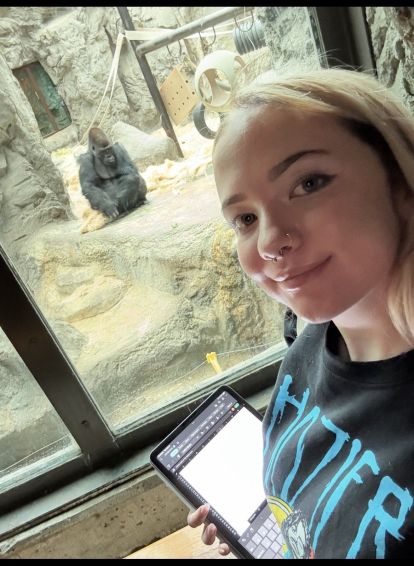
“This research is very important to me since gorillas are a special interest of mine,” Chloe explains. “I haven’t started analyzing the data yet, but I’ve been preparing by collecting observations weekly. Now that I’ve been trained to organize and manage the behavioral database, that’s what my days will consist of going forward.”
Chloe says the hands-on work has given her a head start that no classroom alone could provide. She says learning in the classroom can be great but being part of Dr. Margulis’s research team since freshman year has introduced her to concepts early and really helped her throughout following semesters.
“There’s a difference between being taught about animal behavior and seeing it firsthand, but both are important,” she said.
For Chloe, those opportunities have also affirmed her decision to study at Canisius. “Although it’s four hours from home, the ABEC program and Dr. Margulis’s research team make it worth it. I think being on the research team as well as having my CEEP project will help my future applications stand out.”
Above all, Chloe says her work reflects a lifelong passion. “My passion has always been for animals. I think there are so many things we can learn from them and study, like cognition, behavior, biological mechanisms, troop dynamics, behaviors seen in captivity versus the wild and more. I am lucky I get to be a part of this program.”
The Canisius Earning Excellence Program (CEEP) is a signature program that supports undergraduate research, hands-on learning, academic excellence, faculty mentorship and career preparation—all hallmarks of a transformative Canisius University education.
Reflecting on both Peyton’s and Chloe’s work, Dr. Margulis emphasizes the bigger picture: “When students are given the opportunity to do authentic research, they don’t just learn science—they become scientists.”
Canisius was founded in 1870 in Buffalo, NY, and is one of 27 Jesuit colleges and universities in the U.S. Consistently ranked among the top institutions in the Northeast, Canisius offers undergraduate, graduate and pre-professional programs distinguished by close student-faculty collaboration, mentoring and an emphasis on ethical, purpose-driven leadership.