
Students in BCH 301L: Introduction to Biochemistry stepped beyond the lab this semester to explore living biochemical systems in Canisius University's own backyard.
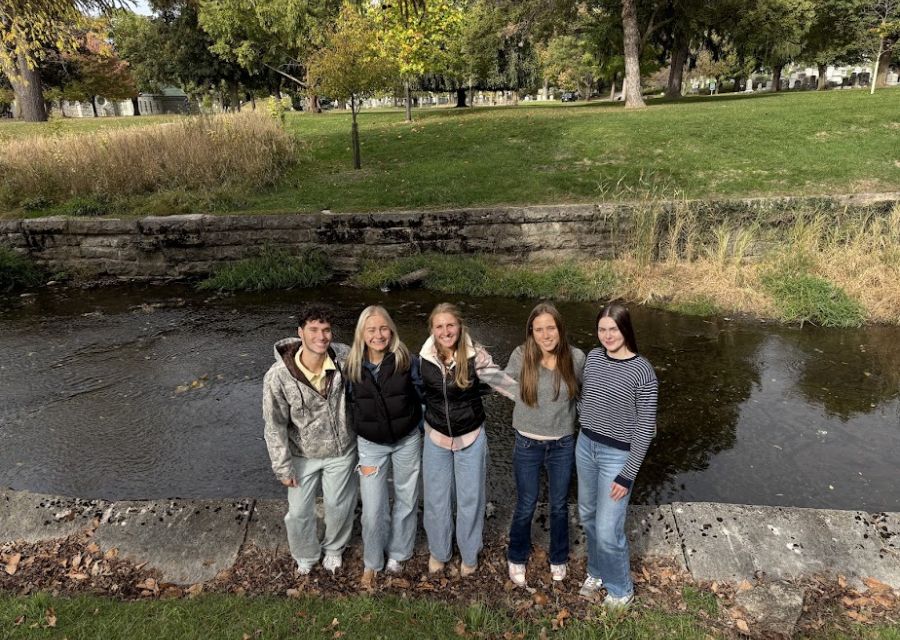
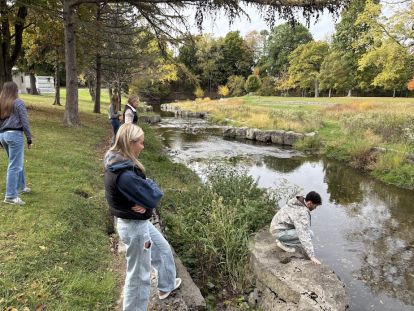
Led by Corey Damon, PhD, assistant professor of biochemistry and organic chemistry, the class conducted hands-on fieldwork in Buffalo’s Forest Lawn Cemetery and along Scajaquada Creek. They studied freshwater ecosystems, collected environmental data and cleaned up litter as part of a service-based scientific experience. The goal: connect biochemical concepts like oxygen transport, metabolism and molecular processes to real aquatic environments just steps from campus.
“By moving the class into the field, students could see those same principles at work in local freshwater ecosystems,” said Damon. “Observing fish species, discussing water quality and interpreting environmental data brings biochemical theory to life.”
[Pictured from right to left: Alex Weiss; Ava Beaudoin; McKenna Zaleski; Olivia Manchester; Ally Chugh.]
Applying Biochemistry Concepts in an Urban Ecosystem
For McKenna Zaleski ’27, a Canisius pre-pharmacy biochemistry major, the experience made learning more meaningful. “Taking our learning beyond the classroom was a really great experience,” Zaleski said. “As we conducted our field work, I was able to relate and apply concepts we discussed in lecture to the organisms and habitats we were observing.”
Students practiced environmental sampling, species identification, and data collection—skills used by biochemists, ecologists and public health professionals. “Students learn to formulate hypotheses, collect and interpret data, and think critically about variation in natural systems,” said Damon. “They also practiced field ethics and safety protocols, mirroring the collaborative and interdisciplinary nature of modern scientific research.”
Service, Stewardship and the Jesuit Mission
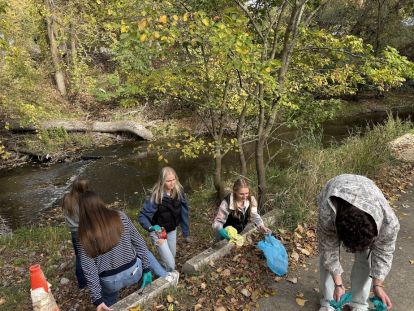
The outing paired science with community service as students helped remove litter from the creek and surrounding grounds.
“The most memorable part of the trip was helping clean up the creek,” Zaleski shared. “It was great to have the whole class working together and seeing part of the creek become cleaner through our efforts.”
Seeing pollution firsthand changed how students think about local ecosystems too. “I was saddened to see how much pollution there was,” she said. “This experience made me more aware of how easily our local ecosystems are influenced by our activities. It’s our job as a community to take care of our natural environments.”
The fieldwork also reflected Canisius’ Jesuit commitment to caring for creation. “The activity embodies the Jesuit call to ‘care for our common home’ by encouraging students to see themselves as stewards of the environment,” Damon said.
Preparing Students for the Future
By stepping into real-world research settings, students gained applied experience that supports their long-term academic and career goals.
“It strengthened my observation and collaboration skills and deepened my curiosity about the natural world,” Zaleski said. “These skills will be essential in helping problem solve and work with others as I continue in higher education and an interpersonal career.”
Damon hopes to expand place-based learning across STEM programs. “The long-term vision is to make such activities a defining element of Canisius biochemistry education,” he said.