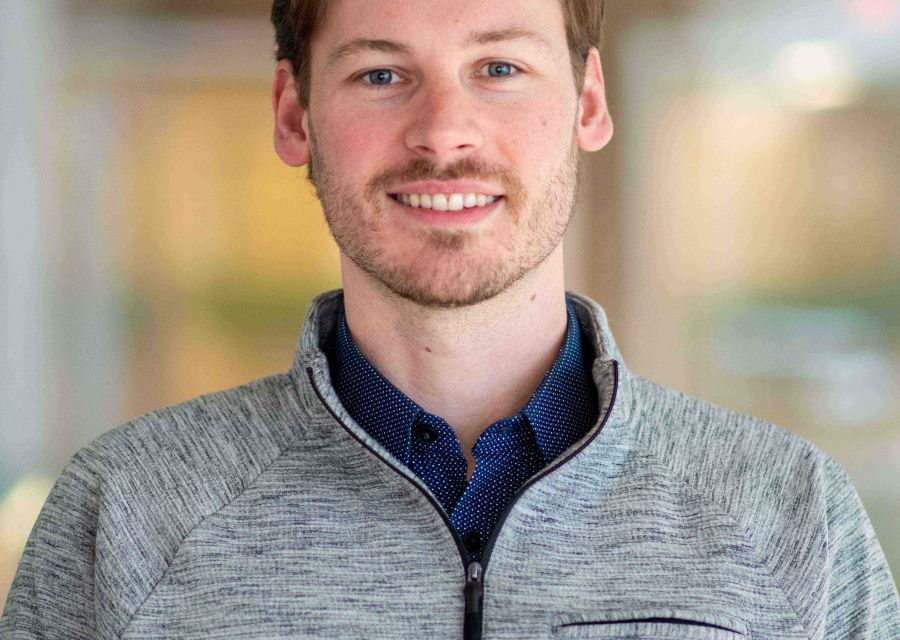
When Geoff Fortman ’17 reflects on his path from Canisius University to his current role as a research engineer at the Michigan Tech Research Institute, one theme rises above the rest: relationships. Whether in the classroom, on the ice or in the lab, Fortman credits the close-knit Canisius environment with shaping how he thinks, learns, and leads today.
A Foundation in Mathematics at Canisius University
A mathematics major at Canisius, Fortman graduated with the highest cumulative average in his class, earning the Rev. Francis A. O’Malley, SJ, Memorial Award, along with the Dr. Robert Tidd Award for Distinction in Mathematics. Yet, by his own admission, his success was never about doing things alone.
“I was very fortunate to have great relationships with many of the math professors at Canisius,” Fortman says. “I learned different skills and material from all of them. To this day, I am still in touch with my former advisor, Dr. Byung-Jay Kahng. The faculty’s passion for teaching and willingness to help students allowed me to understand my math courses at a fundamental level.”
Those relationships extended beyond coursework. Through math seminar courses and support from the Canisius Earning Excellent Program (CEEP), Fortman was introduced to academic research—an experience that would ultimately define his career path. “It was my introduction,” he says, “which is what I now do for a living.”
Academic Excellence and Award-Winning Achievement
Fortman is quick to note that his academic achievements were rooted not in effortless brilliance, but in collaboration and persistence. “I was never a student who got a perfect score on standardized tests or could ace tests without studying,” he says. “I did well by studying in the library with classmates and going to faculty office hours, building relationships.”
That same mindset continues to guide him professionally. “In my career, I’ve found that it is much more effective to learn how to get help from others than it is to try to work in isolation.”
The personalized attention Fortman received at Canisius proved especially valuable as he transitioned to graduate study at a larger institution. “That type of learning environment was a great fit for my personality and learning style,” he says.
At the University of Michigan, where Fortman began graduate school during the COVID-19 pandemic, the contrast was stark. “I couldn’t build those same relationships like I had at Canisius,” he recalls.
Later, as a graduate teaching assistant for large undergraduate courses, he saw firsthand how easily students could get lost in a system where instructors hardly knew their names. “I am grateful for my path from a smaller undergrad university like Canisius to a larger university for grad school,” he says.
Division I Hockey and Leadership on the Ice
While the classroom was foundational, Fortman’s growth as a leader was forged on the ice. Recruited to Canisius for hockey, he went on to captain the Division I men’s hockey team for two years.
“The hockey program definitely had the biggest impact on my personal growth and leadership,” he says. Competing alongside teammates and learning from coaches instilled lessons that extended far beyond the rink. He also noted that the ability to communicate openly with professors allowed him to balance demanding academics with Division I hockey travel without falling behind. “I could quickly get help and feedback as soon as I found myself struggling.”
In addition to hockey, Fortman was active in the Student-Athlete Advisory Committee (SAAC), where he engaged with leaders from across Canisius athletics. Through SAAC, he attended an NCAA Leadership Forum—which he describes as “a phenomenal learning experience that still influences me today.”
As a student-athlete, Fortman learned skills like time management, communication and discipline. But one lesson stands out as more enduring. “A less obvious skill I gained was trust,” he says. With limited time and countless responsibilities, Fortman says he was forced to trust classmates, tutors, faculty, coaches and teammates. “Above all, team sports taught me how to focus on my role and trust my teammates to do their jobs. The best teams often have the strongest culture of trust.”
That philosophy continues to guide him as a researcher working in signal and image processing, machine learning and engineering—fields that might seem far removed from pure mathematics. But for Fortman, the connection is clear. “Math is the foundation of all science and engineering,” he says. His graduate advisor told him he was admitted to Michigan’s electrical and computer engineering program specifically because of his math background. “She said that it was much easier to teach someone with a math background how to do image processing or machine learning than the other way around.”
Even today, that foundation continues to open doors. “Having a background in math still expands my project responsibilities and career possibilities,” he says. Some of Fortman’s most lasting lessons came not from equations or experiments, but from reflection. During his junior year, former Canisius hockey coach Dave Smith recommended he read the book, “Strengths-Based Leadership: Great Leaders, Teams, and Why People Follow.”
The message resonated deeply. “Every leader is unique and every leader needs to play to their strengths,” Fortman says. “When you try to imitate the leadership style of other leaders that you admire, people will sense a lack of authenticity.” That realization helped him develop his own leadership style—as a team captain, researcher and professional. “Truly innovative thinkers find their own unique path,” he says.
A Liberal Arts Education with Real-World Impact
Looking back, Fortman says he’s come to appreciate the broad liberal arts education he received at Canisius. While his job may be described as solving math and science problems, he notes, “Research is a lot of writing and presenting and networking. Having a well-rounded skill set is a huge benefit.”
For students who feel uncertain about where their major—or life—might lead, Fortman offers reassurance born from experience. “Besides being a hockey player, I never knew what I wanted to do when I grew up,” he says. “Set goals, make the best decisions you can with the information that you have, and then enjoy the process. The most important things in life have no final destination."
Whether wearing jersey number 4—a favorite since childhood—or tackling complex research challenges, Fortman continues to embody the values he cultivated at Canisius: curiosity, collaboration and trust in both himself and those around him. And if he could offer one piece of advice to his freshman self and current students? It’s simple: “Forgive yourself. You can’t control everything the way that you wish you could. Your mistakes and your imperfections are what make you a relatable human.”
Additional Background: Fortman was a Division I NCAA men’s hockey player at Canisius and served as a two-year team captain from 2015 to 2017. He was recognized three times with the Canisius Hockey Community Outreach Award (2015, 2016, and 2017) and was named a Hockey Humanitarian Award nominee and Unsung Hero Award finalist in 2017. Following graduation, Fortman continued his hockey career professionally, playing during the 2017–18 season with the Cincinnati Cyclones and Rapid City Rush of the ECHL, before competing internationally in 2018–19 with the Chamonix Pionniers of France’s League Magnus in Chamonix, France.