
Buffalo, NY— As global agriculture faces mounting pressure from climate change, food insecurity and environmental degradation, a Canisius University biology professor and his undergraduate research team are helping shape natural approaches to crop defense.
Robert Grebenok, PhD, professor of biology at Canisius University, is part of an interdisciplinary research team awarded a three-year, $750,000 grant from the U.S. Department of Agriculture (USDA) to study how crop plants can protect themselves against insects while reducing reliance on chemical pesticides. The project brings together researchers, farmers and industry partners from Canisius University, Texas A&M University and the Cotton Growers Association Inc., with Canisius undergraduates playing a role in the work.
“This research began more than 30 years ago, and undergraduate students have always been central to it,” says Grebenok, noting the ability to obtain federal research money is based almost solely on the ability of the team to generate a relevant proposal and maintain the skills to do the job, as assessed by the federal grant review panel.
“What helps a great deal is having an international reputation in a particular area and publishing many review, protocol and research papers that demonstrate your abilities in a particular area,” said Grebenok. “My background in large-scale research and biotechnology gave me perspective on societally important projects, which I’ve continued at Canisius by involving undergraduate students.”
Applying Classroom Science to Global Challenges
At Canisius University, undergraduate students are not observers but active contributors to this federally funded research—an intentional choice that reflects the university’s Jesuit commitment to experiential learning and cura personalis.
“Undergraduates have little training at first, so mentoring them is time-consuming but incredibly fulfilling,” Grebenok says. “Canisius University generously supports the research training of all labs in the biology program, and they have done so since my arrival here. The research grant provides extra research support for supplies, travel and publications,” he added.
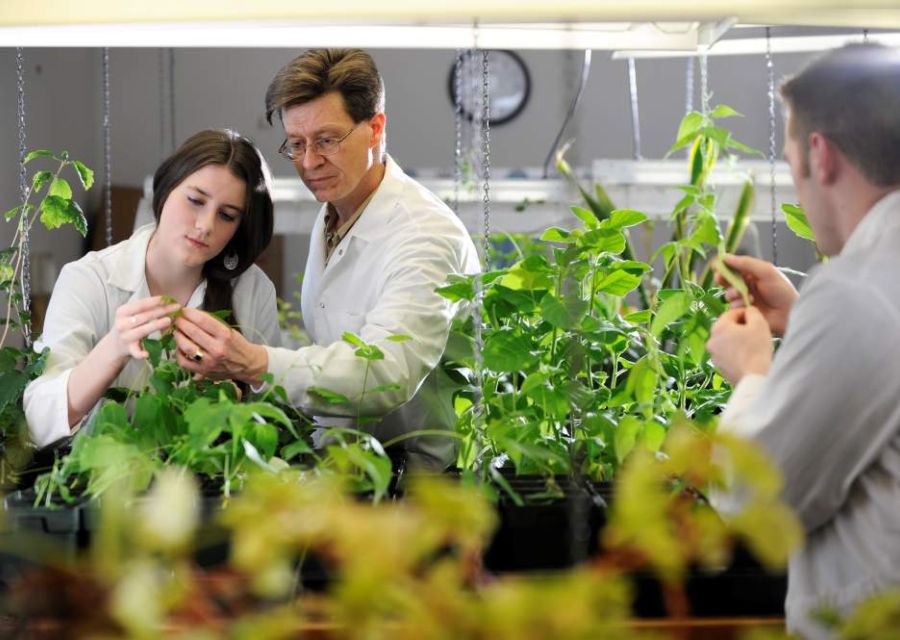
Students in the lab conduct experiments, analyze data, contribute to publications and present findings at conferences. Along the way, they develop both scientific expertise and professional confidence. “Research is about making mistakes and correcting them,” Grebenok adds. “Students learn there are no shortcuts to generate valuable outcomes. The process builds focus, dedication and an understanding of how their work can positively impact society.”
Students as Active Research Partners
Dr. Grebenok’s son, Nicholas Grebenok ’26, a dual biology and animal behavior, ecology and conservation (ABEC) major, is part of the USDA-funded project. “I became a member of Dr. Grebenok’s lab during my freshman year, and I’ve been involved in multiple projects with publications and international presentations,” says Nicholas. “Thanks to the USDA grant, this project is incredibly impactful, and I’m excited to be part of it.”
His role focuses on evaluating how genetic modifications affect plant growth and efficiency. “I measure biomass accumulation and photosynthetic efficiency in modified versus unmodified plants,” he explains. “The goal is to identify the precise level of genetic modification that produces optimal plant performance.”
Beyond the laboratory, Nicholas sees the research as directly connected to global challenges. “Our team is focused on improving edible biomass production to help combat food insecurity worldwide,” he says. “If we can increase crop yields without expanding agricultural land, we can also support conservation and reduce climate change through increased carbon dioxide uptake.”
Nicholas’ experience reflects the lab’s broader commitment to engaging students early on—an approach that has helped shaped the career path of Rory Warren ’28.
A biology major on the pre-medical track, Warren said she joined the lab as a freshman after reaching out directly to Grebenok. “I wanted to be part of research that has a larger environmental impact,” Warren says. “This project allows me to apply what I’ve learned in my Canisius biology and biochemistry courses to real-world challenges.”
Despite being early in her academic career, she was welcomed into the lab and received close mentorship. “Dr. Grebenok took the time to explain the ‘why’ behind every procedure,” Warren says. “He fosters an environment where asking questions is encouraged, which builds confidence and real understanding.”
Warren contributes to experiments involving chloroplast isolation, photosynthetic activity and chlorophyll analysis—work that helps the team understand how biochemical changes affect plant health and defense. “These techniques allow us to see how small molecular changes connect to larger biological systems,” she says. “It has strengthened my problem-solving skills and reinforced the importance of evidence-based thinking—skills that will be essential in medicine.”
Warren has presented the research at Canisius University’s Ignatian Scholarship Day and at a community Juneteenth event in Williamsville, where she helped translate complex science to a public audience.
Beyond the Grant: Confidence, Leadership and Purpose
For Grebenok, the impact of the USDA grant extends well beyond scientific outcomes. “Students in this program generate, organize, present and publish their research,” he says. “I’ve seen them become leaders of projects, take ownership of outcomes and gain confidence in their abilities.”
He notes federal funding supports essential research costs while creating meaningful opportunities for undergraduate collaboration and professional development. “These experiences help students move on to graduate programs and professional schools,” Grebenok adds. “But more importantly, they leave understanding that their work can address society’s most pressing needs.”
As the project continues, Canisius University undergraduates remain at the forefront—advancing sustainable agriculture while gaining the skills, perspective and purpose that define a Jesuit education.