
At Canisius University, research isn’t reserved for graduate students. Sometimes, it begins with an undergraduate’s curiosity — and a simple conversation with a professor.
That’s exactly how an innovative biochemistry lab — and a published research paper — came to life.
When Joe Pivarunas ’26 approached Assistant Professor of Chemistry/Biochemistry Corey Damon, PhD, about conducting research, the two began exploring how they could come up with a meaningful project. What began as a workable plan to reimagine a lab experience ultimately culminated in a peer-reviewed publication co-authored by Damon, Pivarunas and chemistry major Alex Szczepankiewicz ’26.
The project highlights what distinguishes a Canisius education — close faculty mentorship and real-world, applied learning opportunities — even at the undergraduate level.
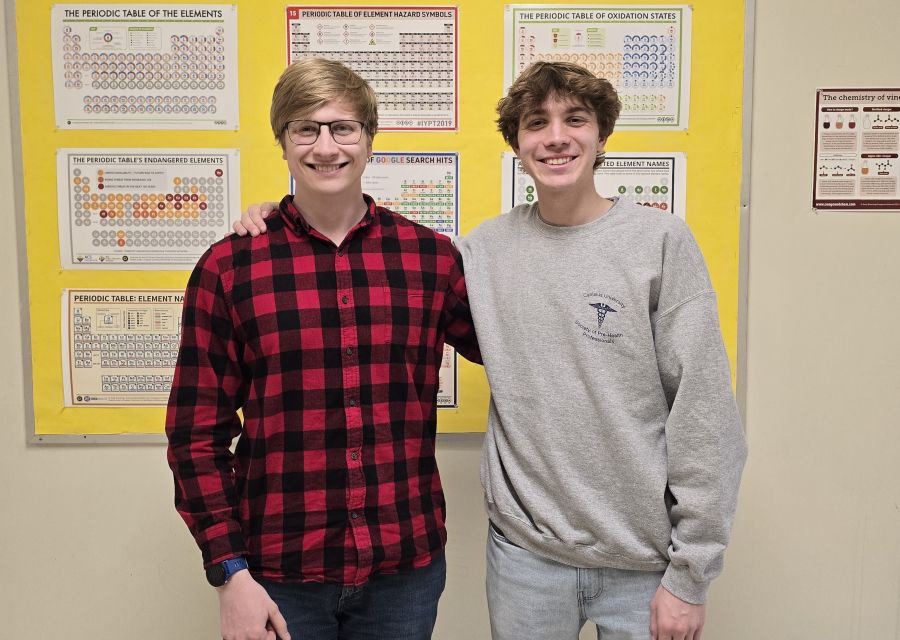
[Pictured left to right are Alex Szczepankiewicz and Joe Pivarunas]
From Curiosity to Collaboration: A Student-Led Research Experiment
Pivarunas, a biology major and member of the cross-country team, had always been fascinated by the human body. “My passion for running naturally grew into an interest in physiology,” he said.
When he discovered that Damon was also an avid distance runner, the two began training together.
Their shared interest and conversations inspired a student-led research experiment to explore the Bohr effect — how higher carbon dioxide and acidity in the blood trigger hemoglobin to release oxygen where it’s needed most.
Pivarunas worked with Damon to design the project— ultimately establishing a new exercise laboratory space in Canisius University’s Horan-O’Donnell Science Building.
Pivarunas said he saw research as something distant and unattainable but that, “Dr. Damon was incredibly open-minded about my ideas, which made it easy to develop a project I was passionate about.”
For this study, he played a leading role, working alongside other students. “I was able to determine the direction I wanted to go,” he said. “Dr. Damon trusted me to be able to organize the research. It helped me become more confident and comfortable in a laboratory setting.”
Biochemistry Brought to Life
The new lab module, Cardio Chemistry: The Human Element, was designed to make biochemistry more tangible, intuitive and personal for students.
Damon explained that biochemistry can feel abstract, especially molecular concepts like the Bohr effect, which are often taught using static diagrams. “We wanted students to experience oxygen delivery rather than just memorize it,” he said about the new lab.
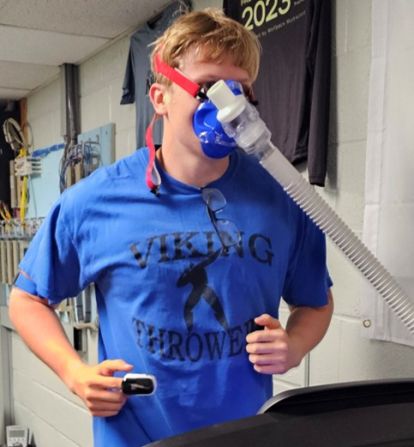
Instead of analyzing anonymous datasets, students examined their own physiological data collected from a guided aerobic fitness assessment. For the assessment, students walked/ran on a treadmill while wearing:
• A metabolic mask to measure oxygen consumption (VO₂) and carbon dioxide production (VCO₂)
• A pulse oximeter to track blood oxygen saturation (SpO₂)
• A heart rate monitor to measure cardiovascular response
The pace and incline were gradually increased from walking to running until the student chose to stop.
“By incorporating movement and real-time physiological data, students could see rising carbon dioxide, changes in oxygen demand and the resulting pH shifts that occur in their own bodies during the exercise,” Damon said. “Instead of interpreting anonymous data, students could now ask, ‘Why did my oxygen delivery change?’”
Turning an Innovative Biochemistry Lab into Publication
Szczepankiewicz, a member of the diving team, joined the project later, assisting with data analysis and research.
The analysis revealed another key finding: students who participated in the activity showed significant gains in conceptual understanding and earned higher final exam scores than nonparticipants.
Together, Damon, Pivarunas, and Szczepankiewicz co-authored a paper demonstrating how movement-based learning in the biochemistry lab enhanced student comprehension.
The manuscript, “Enhancing Biochemistry Education Through Movement-Based Learning: Investigating Oxygen Delivery Using Personal Health Data,” was published by the American Chemical Society (ACS) — a notable accomplishment for undergraduate researchers.
“Being a co-author on this paper meant the world to me,” Szczepankiewicz said. “It gave me the chance to contribute to science while learning the process of preparing and submitting a paper for publication.”
Working closely with Damon also shaped his perspective on leadership and mentorship. “I learned what kind of scientist and leader I want to become,” he said. “Dr. Damon gave me a lot of responsibility but was always there to answer questions and guide me in the right direction.”
A Model for Experiential Learning at Canisius
The project reflects a broader shift at Canisius toward experiential, interdisciplinary learning, a focus Damon supports as part of the university’s strategic plan.
“As wearable technology and data analytics become more accessible, we have powerful opportunities to integrate real-world data into science education,” he said.
He also noted that by bridging chemistry, biology and physiology, the lab pushed students beyond memorization. “By understanding how oxygen delivery works in their own bodies, they gained both scientific insight and practical literacy that can translate directly to post-graduate careers,” Damon said.
For Pivarunas, the experience reflects what makes Canisius distinctive. “Whatever your interests or passions are, there is a research lab for you,” he said. “And if not, like in my case, you can help create one with the support of a professor.”