
As students crossed the stage at Canisius University this spring, another group of graduates was celebrating the end of a successful semester: the dogs of the Applied Dog Behavior course.
After 10 weeks of training sessions, enrichment games and plenty of treats, the canine participants completed the semester with stronger skills, increased confidence and improved communication with their human companions. At the same time, students in the Animal Behavior, Ecology and Conservation (ABEC) and Anthrozoology programs gained invaluable hands-on experience in humane, science-based animal training.
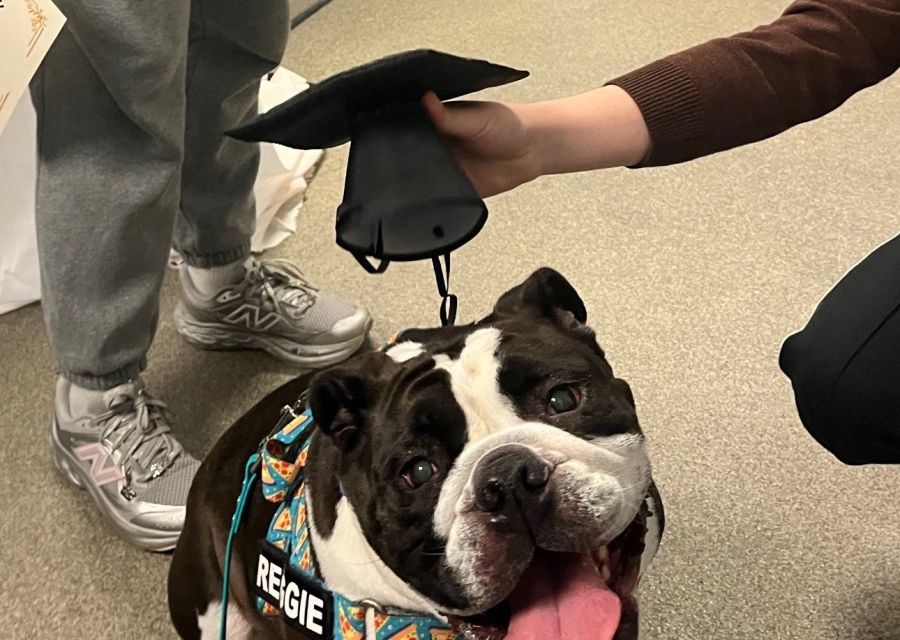
For Emma Schiedel ’22, participating in the program with her 3-year-old English Bulldog, Reggie, also marked a meaningful return to campus. “As a Canisius alum, it was honestly special coming back to campus in a completely different stage of life — this time with my dog instead of as a student myself,” says Schiedel. “It felt very full circle.”
Schiedel enrolled Reggie in the Applied Dog Behavior course led by Maura Tyrrell, PhD, the experiential learning coordinator for ABEC and certified professional dog trainer.
“Reggie is such a huge part of my life, so being able to participate in something connected to the university while also helping students gain hands-on experience was meaningful to me,” Schiedel says. “You could tell how passionate and invested the students were, and it was rewarding knowing Reggie was helping them learn in a real-world setting while also benefiting himself.”
Learning Through Hands-On Dog Training
[WATCH REGGIE DOING SCENT WORK ] [WATCH REGGIE PLAYING AN EYE CONTACT GAME]
The Applied Dog Behavior course combines learning theory with practical experience, giving students the opportunity to create individualized training plans for dogs owned by faculty, staff, students and community members.
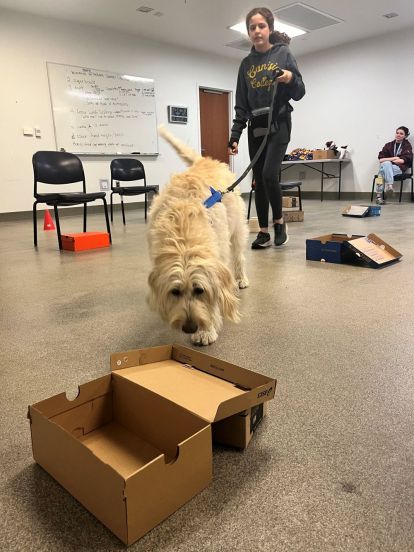
The course builds on concepts introduced in Animal Learning, a prerequisite course in which students study operant and classical conditioning while working hands-on with foster kittens. In Applied Dog Behavior, students expand those skills by training dogs in real-world scenarios using force-free, positive reinforcement techniques. Training sessions take place twice each week in the Animal Behavior Lab in Science Hall, where students work directly with dogs on skills that help them successfully navigate everyday life with their families.
Training may focus on skills such as:
• Walking politely on leash
• Settling calmly on a mat
• Leaving items on the ground
• Greeting people calmly
• Maintaining focus around distractions
• Participating in scent work and enrichment games
Students also learn how to “proof” behaviors by practicing them in different environments and around increasing distractions to improve reliability outside the classroom. “Every dog is different,” says Tyrrell. “Every dog has a unique learning history, different motivations and different preferences. Rather than using a one-size-fits-all approach, students learn how to adjust training plans based on the dog in front of them.”
Building Humane Solutions Through Science
The course emphasizes ethical, welfare-focused approaches to behavior and training. In class, students learn how to evaluate why behaviors occur and how to reinforce alternative responses that are more effective and appropriate. Rather than relying on aversive methods, the training philosophy centers on positive reinforcement, enrichment and strengthening the relationship between dogs and handlers through trust and cooperation. Students also incorporate enrichment activities such as scent work, which encourages dogs to use their natural sense of smell to locate hidden treats or odors.
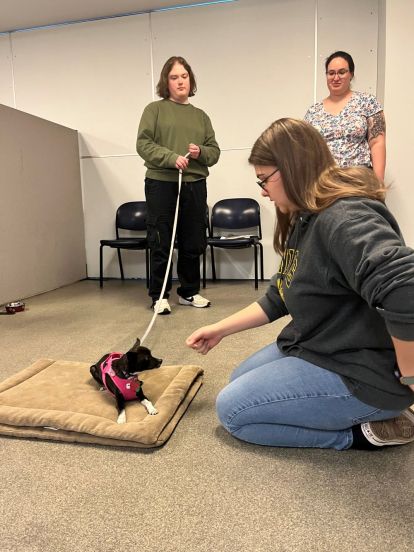
“Scent work builds confidence, promotes problem-solving and provides mental stimulation,” Tyrrell explains. “These activities improve overall well-being and can become an important part of behavior change plans.” For Reggie, scent work quickly became a favorite.
“Reggie has a big personality and can be stubborn at times,” says Schiedel. “He’s an incredibly sweet dog, but we wanted to continue building his confidence, mental stimulation and overall behavior skills in different environments.”
She says one of the highlights of the program was watching Reggie learn to identify and signal when he found the scent birch during scent work exercises. “Bulldogs can sometimes get labeled as lazy, but Reggie loves having a ‘job’ to do and engaging with people,” she says.
A Transformative Experience for Students
For many students, the course becomes one of the most impactful parts of their education. Megan Greenberg ’26, a dual major in ABEC and psychology with minors in zoo biology and business management, now serves as a teaching assistant for the course after taking it herself. “Even before coming to Canisius, I was extremely interested in animal training,” says Greenberg. “I realized that while I generally understood the training process, I was lacking the formal foundation for why certain procedures were successful.”
Greenberg says the course’s hands-on nature taught her that successful training requires flexibility, creativity and careful observation. “When I was a student, the dog I worked with struggled with polite greetings because she became so excited around new people,” she says. “We tried several approaches with little progress until we used a pattern game to maintain her focus while someone approached. The progress was immediate. It taught me one of the most valuable lessons in training — if something isn’t working, don’t be afraid to adapt.”
That experience continues to shape the way Greenberg mentors current students in the lab. “I remind students often that flexibility in training is vital,” she says. “I hope it helps them stay focused on learning from the experience rather than getting discouraged during difficult moments.”
Preparing Students for Careers in Animal Behavior
The skills students gain in Applied Dog Behavior extend far beyond working with dogs. Greenberg, whose career goal is to become a behavior and welfare curator at a zoo or aquarium, says the course directly prepared her for internships in animal training and behavior, including work with the U.S. Navy Marine Mammal Program and the Buffalo Zoo.
“Training and behavior modification principles are applicable across species,” she says. “In the grand scheme of things, the way you train a dog is not very different from the way you’d train any other animal.”
Tyrrell says the course provides foundational skills for careers involving animal behavior, welfare and training, including dog training, shelter work, zoo and sanctuary care, and animal behavior consulting. “This course gives students practical, real-world experience that is highly valuable in the field,” she says.
Personalized Attention for Every Dog
One aspect of the program that stood out to Schiedel was the individualized attention students gave each canine participant. “I was impressed by how thoughtful and personalized the students were with every dog,” she says. “You could tell they truly cared about the dogs and wanted both the dogs and owners to succeed,” she added.
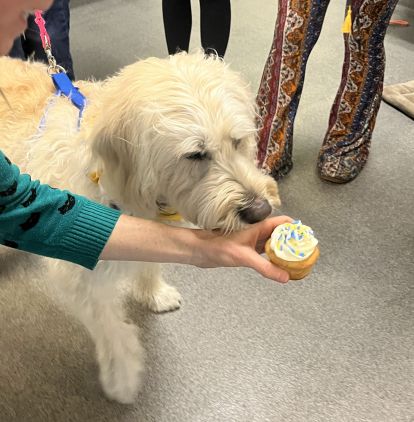
By the end of the semester, each dog receives a diploma and leaves the program with new skills, stronger confidence and a few extra treats along the way. Students leave with the hands-on experience, adaptability and compassion that will shape their future careers in animal behavior and welfare.