
Canisius University welcomed nearly 100 Buffalo Public Schools students to campus on June 3 for the annual Girls Who Game (GWG) awards celebration, a day filled with creativity, discovery and excitement. The GWG program uses Minecraft Education to engage students in solving real-world challenges while building skills in coding, collaboration, critical thinking and leadership.
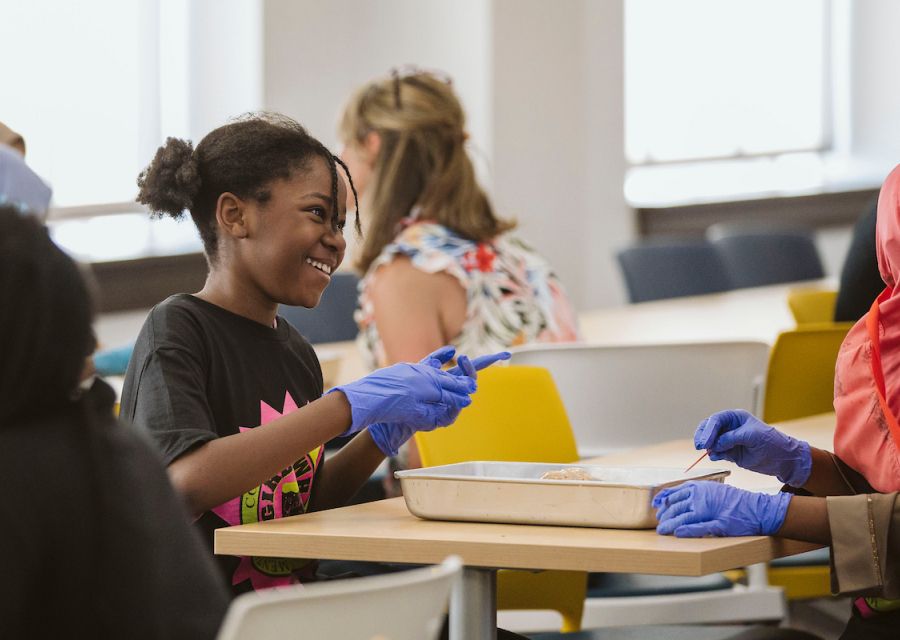
Girls in grades 4–8 from eight Buffalo Public Schools spent the day on campus taking part in hands-on STEM (Science, Technology, Engineering and Mathematics) activities led by Canisius faculty, touring campus facilities and celebrating their accomplishments at an awards luncheon hosted by the university. The experience also gave students a firsthand look at college life, helping them connect classroom learning to future possibilities in the STEM fields.
"Having Canisius host our celebration sends a powerful message to these girls that they belong in spaces like this," said Amy Burdette, coordinator of student technology programs for Buffalo Public Schools. "Experiences like campus tours and hands-on STEM activities help students see themselves as future college students, innovators and leaders."
Throughout the day, Canisius professors introduced students to a variety of STEM disciplines through engaging, interactive activities:
• Elizabeth Hogan, PhD, associate professor of biology, led a “Brain Anatomy Competition” that brought neurobiology to life through hands-on sheep brain exploration. After learning about key human brain structures, students dove in to identify and match those same structures in real specimens.
• Katie Costanzo, PhD, professor of biology and environmental science, introduced students to the fascinating world of insects through her interactive “Insect Zoo.” During the session, students explored a variety of preserved insect specimens and learned about the remarkable diversity and adaptations within the insect world. They also took part in an activity that challenged common assumptions about “good” and “bad” insects.
• Jonathan O'Brien, PhD, associate professor of biology and environmental science, guided students through “Follow the Light: The Daphnia’s Dilemma,” an experiment exploring how tiny aquatic organisms (zooplankton) respond to different colors and intensities of light while feeding and avoiding predators.
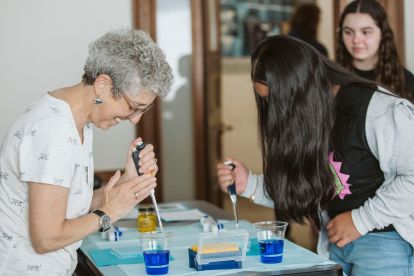
• Sue Margulis, PhD, professor of animal behavior, ecology and conservation, engaged students with a “Gorilla Matching Game” focused on facial identification, as well as “Pipette Races” that demonstrated laboratory pipetting techniques used in scientific research. Students then competed against her to fill the 96 wells of a microtiter plate with colored water.
Watch local news stories about the event here [WKBW Channel 7] [WIVB Channel 4]
Read Buffalo Toronto Public Media NPR's story here.
Faculty members emphasized the importance of exposing students to STEM fields early, particularly during the middle school years when interests and future aspirations begin to take shape.
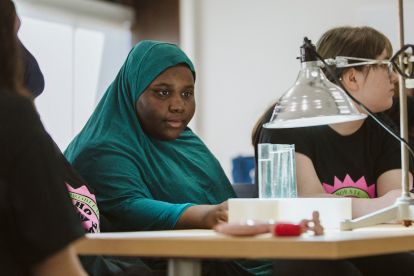
“The transition from middle school to early high school is a crucial time for kids to engage in science, especially for girls,” said O'Brien. “Kids are trying to establish their self-concepts and identities. Events like this allow students to see that science is more than a collection of facts in a textbook. They can explore, experiment and discover alongside classmates who share similar interests."
Costanzo noted that hands-on experiences help students connect their natural curiosity to future careers and begin to see themselves in STEM pathways. “By engaging young students with science in meaningful ways, we can inspire environmental awareness, build confidence and help them see college as a place where they belong. Early exposure to science and higher education can spark curiosity, build comfort and confidence, and encourage students to explore future opportunities in STEM,” she said.
Costanzo added that this exposure is especially important for girls, who remain underrepresented in many STEM fields, a reality echoed by her colleagues.
For Margulis, representation plays a critical role in shaping how students see themselves in science. “It’s never too soon to get girls interested in science. They are often discouraged at young ages,” she said. “And most kids interested in animals assume they will be veterinarians, but there are many things they can do. Studying animal behavior is one way to get this idea across. When students see role models and experience science firsthand, they begin to imagine themselves in those careers.”
O’Brien added that the college setting itself is a powerful part of the experience. “It’s important to give kids a chance to spend time and have a positive experience on a university campus like Canisius,” he said. “Many students may see college as a distant thing that is for others. These events give students a chance to look around and begin to think, ‘this is a place for someone like me.’”
The impact of that experience was evident in moments both big and small. After a pipette demonstration, one student turned to her teacher and said, “This makes me want to be a scientist.” A simple comment, but one that captured the purpose of the event: sparking curiosity, building confidence and helping young learners envision themselves pursuing a future career in one of the STEM fields.