
Buffalo, NY — At the bedside of someone’s final moments, silence often speaks louder than words.
For students from Canisius University, that quiet became a teacher of one of the most powerful lessons of their education — one that cannot be learned from textbooks alone.
Through specialized training, a group of undergraduate students discovered that medicine is not only about treating illness but about presence, dignity and care as they served as mercy doulas at Sloan Comfort Care Home, where they learned to provide companionship and steady support to those nearing the end of life.
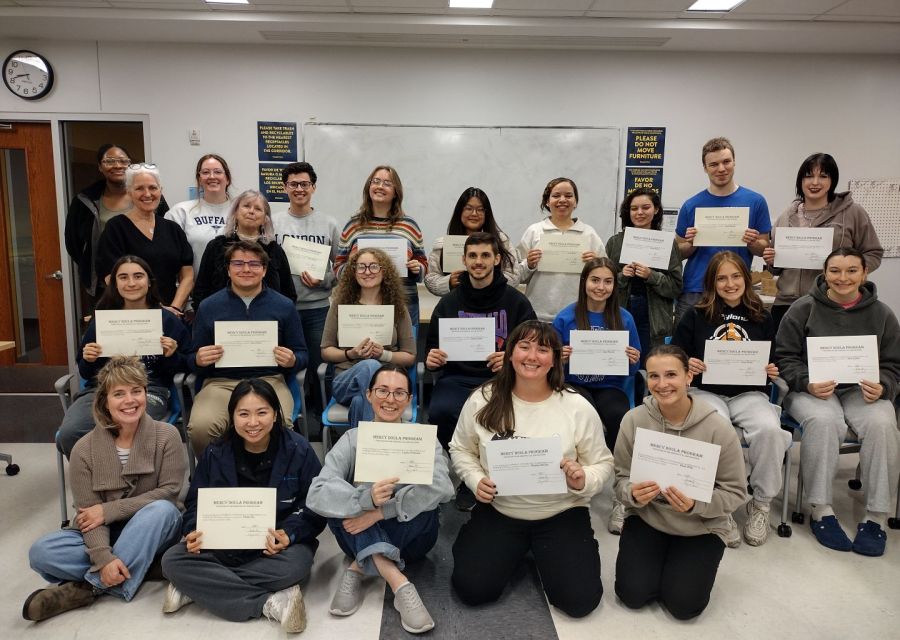
[Photo: Fall 2025 undergrad, PA and MA students, along with their trainers, display mercy doula training certificates.]
A Setting for Transformative Learning
Founded in 2021, the Sloan Comfort Care Home provides a place for terminally ill individuals to “come home” when they are unable to return to their own residence due to unstable housing or a lack of caregiving support. Located in the former convent at St. Andrew Catholic Church in Buffalo, the home works in partnership with the church, which assists with building maintenance and spiritual support.
Established by Kathleen Grimm, '77, MD, a retired palliative care physician from Erie County Medical Center and Sandra Lauer, director of continuum of Care Palliative Medicine & Supportive Care at ECMC, the home relies on a mix of paid caregivers and community volunteers. It receives no government reimbursement and operates under strict state regulations.
The Canisius program grew from years of collaboration between Grimm and Allyson Backstrom, PhD, director of Canisius University’s Dr. George E. Schreiner ’43 Pre-Medical Center. “Throughout my time at Canisius, Dr. Grimm has helped teach our students about health equity, medical ethics and compassionate care,” Backstrom said. “When she introduced mercy doula training, we saw how transformative the experience could be for students.”
Over the spring 2024 and the fall 2025 semesters, Griffs served as mercy doulas, accompanying guests during the last journey of their lives. The interdisciplinary program brought together a mix of premed, pre-PA, pre-pharm, pre-nursing and even pre-vet undergraduate students with Canisius physician assistant students and medical students from the Jacobs School of Medicine and Biomedical Sciences at The University at Buffalo.
“Our undergraduates took the training as part of a service-learning course and were every bit as mature and thoughtful as the PA and MD students. Their response to their time at Sloan was impressive,” said Backstrom, who believes the experience will shape how students approach future healthcare conversations.
The program also reflects the Jesuit value of cura personalis — care for the whole person — that a Canisius education embodies. “Doulas care not only for the body, but also the mind and spirit. At Sloan, guests are treated as individuals, not patients,” she said. “The training encourages thoughtful dialogue about what makes life meaningful. It helped students become more empathetic and compassionate when caring for patients and families,” she said.
Students Learning the Human Side of Medicine
Grimm observed Canisius students step into their roles with compassion, openness and a deep sense of purpose.
“Students become part of the fabric of care that defines the Sloan community,” Grimm said. “They offered companionship and empathy to those in their final days.”
She explained that students quickly learned the power of listening without judgment. “The transformation happens when they realize every guest arrives with a unique life story,” Grimm said. “Their ability to listen allowed guests to share their personal journeys and stories freely. This form of experiential learning deepened the students’ understanding and fostered meaningful connections, often providing comfort that extended beyond basic physical care.”
Grimm believes the experience prepares students for healthcare careers in ways traditional coursework cannot, and has even deepened her own perspective.
“Working alongside students influenced my thinking. It showed how compassion, communication and presence can be taught,” she said. “In healthcare, empathy and presence are often as important as clinical problem-solving.”
Lauer agrees with Grimm. She witnessed firsthand how students’ training shaped the experience of a dying guest. “We had a guest named Grace, whom many of our students had come to know well,” Lauer said. “However, on the day she was actively dying, a new group of students happened to be present. I explained her family would arrive soon.”
With little prompting, Lauer said the students transformed the room into a peaceful space — arranging family photos, playing soft music and sitting quietly at her bedside. “I was deeply struck by their response. When the family arrived, the students respectfully excused themselves to allow the family to enter the sacred space they had created,” Lauer said. “In that moment the students demonstrated a profound understanding of what it means to create a healing environment. They showed how dying is not just a medical event but a deeply human passage.”
Student Experiences: Lessons That Shape Future Physicians
Through their time at the comfort home, students encountered moments that deepened their understanding of medicine, compassion and human connection. Here are a few of their experiences:
Cory Walck ’26 — Compassion Through Presence
Biochemistry major Cory Walck, who plans to attend medical school and become a family physician in Buffalo, initially hesitated to confront topics of death and dying, and dealing with grief. “After thinking about it, I decided it would be a good way for me to get out of my comfort zone,” Walck said.
While volunteering, Walck formed a meaningful connection with a specific guest who was initially reluctant to communicate. Over time, he gained the individual's trust. “I learned a lot about his life. I would make it a goal to help him shower whenever he was feeling up to it to help him get comfortable,” Walck said. “This was a moment that made me realize that showing up for a person, no matter how big or small, has a profound impact. Compassion can be small gestures, open communication or simply a quiet presence,” he said.
Walck said the experiences that he had in the comfort care home will always have an impact on how he navigates his career. “I will practice under the principle that medical care does not exist without caring for the whole person and will do my best to develop strong relationships with patients to foster an environment of trust and compassion.”
Evan Folsom ’26 — Understanding Grief, Ethics and Humanity
Biochemistry and philosophy major Evan Folsom joined the program seeking deeper insight into the moral dimensions of medicine. He is currently applying for a master’s program in bioethics and upon completion of his master’s degree wants to attend medical school with the end goal of being an oncology/hematology physician.
A powerful moment for him was realizing grief is not something to move past. “In these moments, grief did not exhibit a common theme or irrationality or confusion but rather emphasized the meaning found in our dependence on others as humans to achieve what it really means to flourish,” he said. “Listening to fears, memories and goodbyes showed me that grief is inseparable from love. I learned the simplicity of compassion — sitting in silence and listening without trying to fix anything,” he added.
The experience also changed how he views healthcare. “Whether intentional or not, some aspects of medicine can be dehumanizing and diminish hope. Through this experience, I hoped to engage in moral and ethical reflection by recognizing the individuality of people, especially at their most vulnerable point — the end of their life,” he said.
Folsom said the experience showed him medicine is just as much a moral practice as a medical one. “Ultimately, it’s a person’s individuality and autonomy that guide decisions about treatment and comfort. This experience — one I could only have at Canisius — is fundamental to the values I hope to carry as a future clinician and individual,” he said.
Tarin Rietz ’26 — Listening, Legacy and Narrative Medicine
Mathematics major Tarin Rietz will attend the Jacobs School of Medicine and Biomedical Sciences in the medical doctor program. With anticipated graduation in 2030, she is interested in practicing geriatric or palliative medicine.
Rietz volunteers at a local nursing home in the Buffalo area but was looking for an experiential learning experience. “This opportunity was very different. The residents of Sloan were truly at the end of their lives, unlike at the nursing home, which is a true mix of mobility-impaired adults.”
Rietz discovered the power of listening. “I conducted life story interviews with guests. I asked open-ended questions and let them tell me their story. After the guest passed away, I gave the recording to their families as a method of legacy preservation,” Rietz said. “The interviews left a lasting impression on me because it was the first time that I felt as though I was really able to help someone and all I was doing was listening.”
The experience deepened her interest in palliative and geriatric medicine. “There’s a hospice philosophy: ‘If you’ve met one dying person, you’ve met one dying person,’” she said, underscoring the idea that every person’s death is unique. “I have come to learn how beautiful and meaningful hospice care can be, and how sacred the end-of-life experience is for the individual and their family,” said Rietz. “A course like this requires major emotional awareness, but there is nothing quite like helping to provide dignity-preserving care to people at the end of their lives. This is a part of humanity that often stays tucked away from the public eye,” she said.
Rietz said that end-of-life care is about understanding what matters most to each individual, but also added, "It’s in these situations that you learn the most about yourself too. I would truly encourage everyone to have an experience like this. It has the potential to change your entire view on life, if you allow it."
Farrah Shidid ’26 — Compassion in the Space Between Life and Death
For Farrah Shidid, a physcians assisant student, the mercy doula training offered a deeper understanding of moments she had witnessed for years working in the emergency room. While she was accustomed to seeing patients die, she had never explored the emotional and spiritual space that exists before that final moment.
At the comfort care home, one encounter left a lasting impression. While dealing with a guest living with dementia, Shidid noticed the woman gently cradling and petting a toy cat as if it were real. “She was quiet, somewhat aware, but completely invested in caring for that cat,” Shidid recalled. “What struck me was her gentleness. It reminded me that the human within us continues to live on despite illness.”
The experience broadened her understanding of end-of-life care and strengthened her empathy. It challenged her to consider how, as a future PA, she can support patients and families beyond clinical treatment. “It was meaningful to hear people’s comfort with death and their end-of-life care. In fact, it made me more aware of the nuances surrounding death and how we can impact patients beyond medicine,” she said. “How can I, as a future PA, make someone feel comfortable? How can I positively support the family unit?”
To students who may hesitate to enroll in the course, her advice is simple: “Just do it. Face the uncomfortable. None of us are immune to end-of-life care. This experience will challenge you — and it will change you for the better.”
Preparing Compassionate Healthcare Leaders at Canisius
Through mercy doula training, Canisius students gained more than clinical experience — they developed empathy, communication skills and the ability to be present in moments of vulnerability. The partnership between Canisius and Sloan continues to shape future healthcare professionals while advancing the comfort home's mission of service and equity.
As Grimm reflected, the most meaningful lessons are learned through presence. “The students’ holistic approach, attentive listening and willingness to connect on a personal level demonstrated a deep commitment to the core value of cura personalis, enriching both their educational experience and the lives of those they will serve,” she said. “While practical skills are acquired through observation and collaboration, the most profound lessons they learned came from being present with those who are most vulnerable.”