
Students from Canisius University expanded their academic and cultural horizons during a spring break study abroad trip to Lisbon, Portugal and Barcelona, Spain.
Designed as a cross-listed course for undergraduate and graduate students, the trip brought together 13 participants from three programs: Anthrozoology, Museum, Cultural and Environmental Education and Animal Behavior, Ecology and Conservation.
Co-led by faculty members Sue Margulis, PhD, and Yvonne Widenor, the one-credit course offered a unique blend of experiential learning that combined visits to world-renowned zoos and aquariums with immersive cultural experiences.
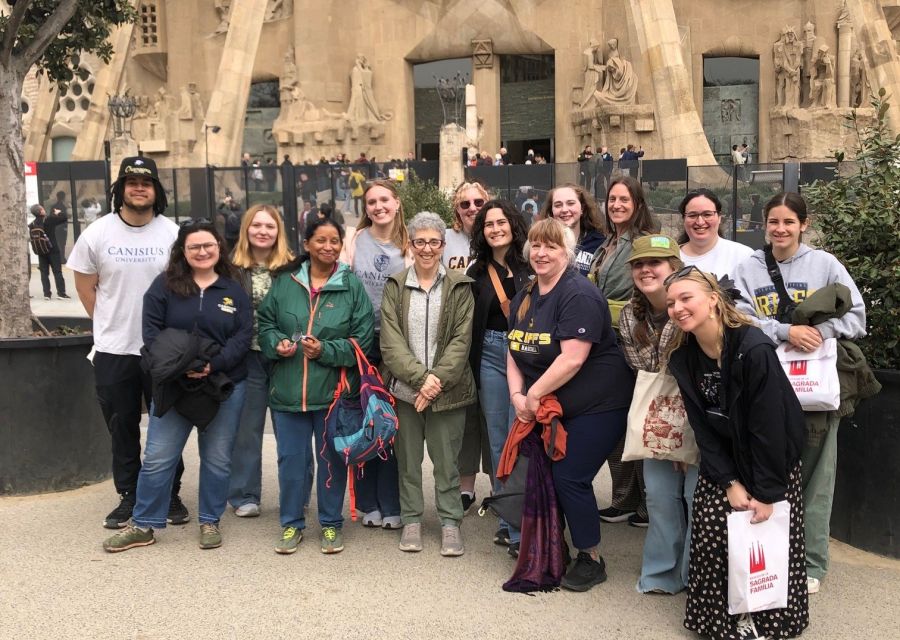
[PHOTO: Canisius University students and faculty pose in front of the Passion Façade of La Sagrada Família in Barcelona, Spain.]
Over the course of the week, students explored how different cultures approach education, conservation and public engagement. For students like Peyton Koukides ’26, that hands-on approach made a lasting impression. “You can only learn so much in a classroom,” she said—an idea that came to life throughout the week.
Learning Beyond the Classroom: A Global Perspective
In Lisbon, students explored both the natural and cultural landscape, beginning at the Jardim Zoológico and the Oceanário de Lisboa, where they examined innovative approaches to animal care and educational design. Their time in the city also included visits to historic landmarks such as Castelo de São Jorge and the Palácio Nacional da Ajuda, as well as a traditional fado performance, offering a deeper understanding of Portugal’s rich history and culture.
In Barcelona, that exploration continued with a mix of iconic sites and academic experiences. Students took in the architecture of La Sagrada Família, observed animal care practices at the Barcelona Zoo and engaged with art and culture at the Picasso Museum and the Museu de la Xocolata. Additional visits to science and natural history museums gave students the flexibility to pursue their individual academic interests, while cultural experiences—such as flamenco and sampling local tapas—further deepened their understanding of each city’s identity.
According to Margulis, one of the most striking aspects of the experience was observing how visitors interact with cultural institutions in Europe compared to the United States—differences that offered valuable insight for students studying animal behavior, conservation and informal education.
“Visitors tend to be more respectful and rule-following,” she explained. “You sometimes see closer proximity to animals or less stringent containment. In museums, it’s common to see young children deeply engaged—even in art museums—which is less typical in the U.S.”.”
Student Reflections: Engagement, Curiosity and Discovery
For Rebecca Williams, MS ’26, a graduate student in anthrozoology at Canisius, the trip highlighted the power of emotional connection in education. “The Oceanário was incredible,” she said. “One exhibit used identifying markers for penguins, helping visitors form a bond with individual animals. That emotional connection helps makes people more invested in conservation.”
Williams also found inspiration in everyday interactions abroad. “My focus is on domestic and liminal animals [part wild and domestic] and their relationships with humans,” she said. “I really enjoyed watching locals walk their dogs and having conversations with them. Those interactions gave me a deeper understanding of everyday life and culture in Lisbon and Barcelona.”
Koukides, who is pursuing a master’s degree in museum, cultural and environmental education at Canisius, described the trip as transformative—especially as her first time traveling internationally. She was particularly struck by the design of the Oceanário and zoo exhibits.
“The aquarium felt like a pure form of art and the open-concept design of the zoos provided ample space for the animals, allowing guests to observe them up close, she said. “It was impressive and highlighted the animals’ well-being.”
She added, “Being fully immersed in culture, architecture and art is a completely different kind of learning. The trip showed me that education doesn’t always need words—sometimes the experience itself is enough.”
Inspiring Exploration and Lasting Impact
Margulis emphasized that exposure to international practices can spark new academic and professional interests, as students gain a broader understanding of how cultural context shapes everything from exhibit design to conservation strategies. “I think it helps students see that the way we do things in the U.S. is not the only way,” Margulis said. “That perspective can inspire new ideas for research and future careers.”
She added that the trip also encouraged students to step outside their comfort zones—whether trying new foods, navigating unfamiliar cities or engaging with different cultural norms
For Canisius students, the experience was both academically enriching and personally meaningful. Moments of discovery—like Rebecca Williams’ unexpected encounter with parakeets near Barcelona’s Arc de Triomf— perfectly captured the joy of exploration. “I became a tourist trap—literally,” she said. “A classmate and I were walking back to our hotel when a flock of Quaker parakeets landed on us. We were given sunflower seeds to feed them. I was thrilled!”
Margulis encouraged students to embrace every aspect of the journey. “Be open to new experiences,” she said. “Travel can be exhausting but it’s also incredibly rewarding. Take it all in.”