
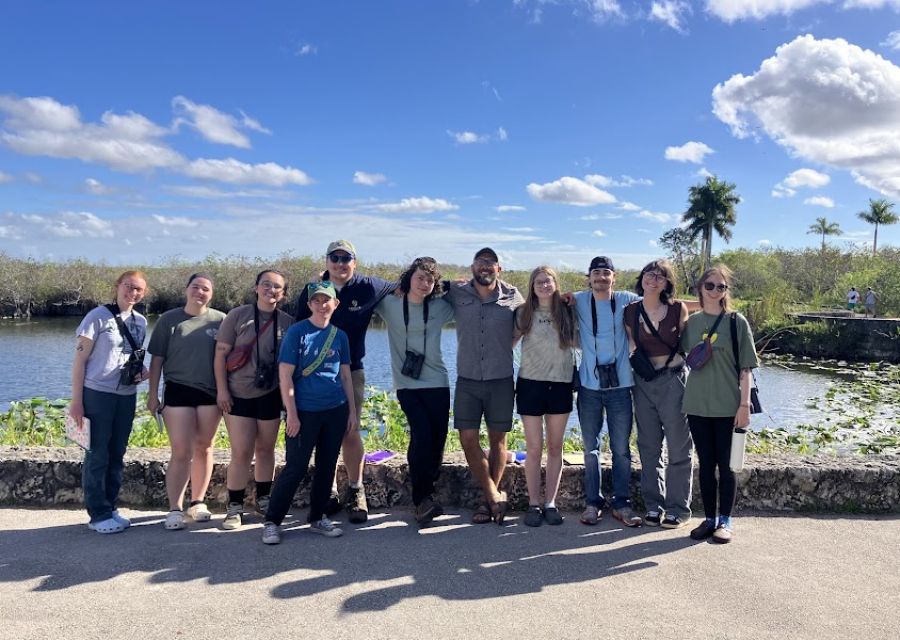
For Canisius University students, a week in the Florida Everglades National Park during winter break offered more than lessons about ecosystems—it became a journey of personal growth.
Experiencing the Everglades firsthand, they saw how this unique environment, once twice its current size, has been drastically altered by development, highlighting the importance of conservation to protect water resources, wildlife and natural defenses against hurricanes.
For Julie Bizub ’26, an animal behavior, ecology, and conservation major with an education minor, seeing classroom concepts come to life was a defining moment.
“Learning about the Everglades’ many ecosystems and then experiencing them firsthand was incredible,” Bizub said. “Seeing the range in temperatures, water levels, salinity and wildlife brought it all to life—learning is interesting, but experiencing it is something so much more.”
She added the immersive experience also influenced her future career goals. “I’ve always planned to go into environmental education, but meeting park rangers and hearing about their experiences really brought that career path to the forefront. I still want to be an environmental educator, but now I’m seriously considering becoming a park ranger as well.”
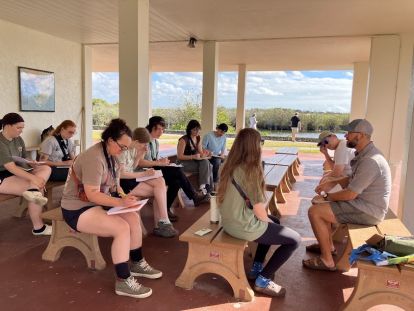
Beyond academics, Bizub said the trip deepened her understanding of environmental stewardship and the importance of education in conservation efforts. “It showed me that people simply don’t know about conservation or what the Everglades has gone through. If people don’t understand an ecosystem, they won’t care about protecting it. That’s why education is so important—it’s how we inspire people to care and take action.”
Experiencing the Ecosystem Firsthand
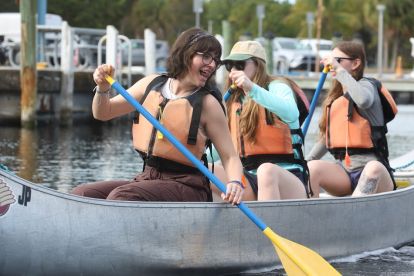
The trip was part of Ecology & Self Everglades, an interdisciplinary course offered through Environmental Studies, Psychology and the Honors program that was introduced in 2024. Led by professors Jonathan M. Roth and Jennifer Lodi-Smith, PhD, the course invites students to explore ecological systems while reflecting on their own growth through hands-on learning.
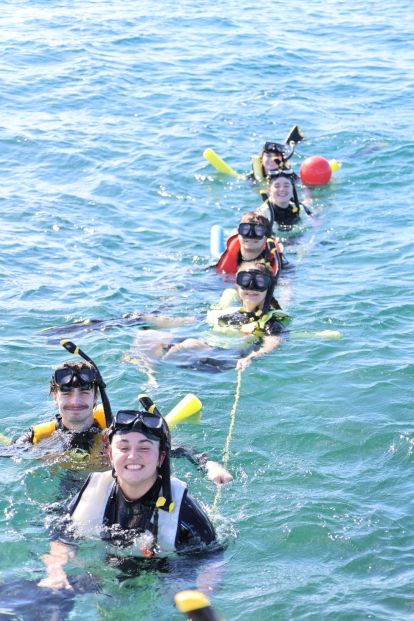
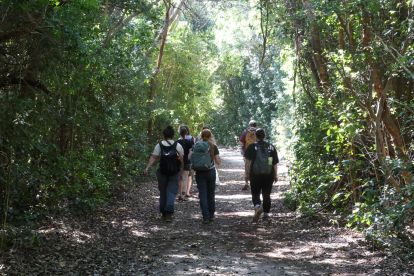
This year, nine students—seven new participants and two returning teaching assistants—traveled with Roth and Lodi-Smith. During the weeklong experience, they camped at Long Pine Key, explored freshwater sloughs and hardwood hammock ecosystems, paddled mangrove-lined canals and snorkeled off Key Largo to study coral reef ecology firsthand.
The course aligns with Canisius’ broader emphasis on immersive, interdisciplinary education outlined in the university’s Answer The Call strategic plan. “Students talk about how they learn differently and better and are more engaged when they are learning in the field like this,” said Lodi-Smith. “Lessons on the ecosystem—particularly the way we connect with and can help the environment—feel more profound.”
Learning Through Reflection and Challenges
Wildlife sightings were plentiful throughout the trip, according to Roth. “We were really shocked at the abundance of wildlife this year,” he said. “We had several wonderful encounters with American alligators, including one of the largest I’ve personally seen in the wild at about 11 feet long. We also saw quite a few American crocodiles along our Buttonwood Canal paddle, which made it memorable along with the herd of manatees that swam by us."
Students documented their experiences through nature journaling and reflective writing—an approach grounded in the university’s Jesuit value of cura personalis, or care for the whole person. “The students challenge themselves to try new things so they can learn through self-expansion,” Lodi-Smith explained. “They begin noticing not only their own strengths but also those of their peers, as well as areas where they need support and growth.”
Moments of uncertainty often turned into opportunities for personal development. Roth recounted one hike in Key Largo when students encountered a flooded portion of trail caused by high tide. “They had the choice to potentially ruin their hiking boots in the salt water or continue barefoot,” Roth said. “Although hesitant, they pushed ahead barefoot. They were uncomfortable, but afterward they said they were proud of themselves for doing it and felt rewarded for handling the situation.”
Even snorkeling—an entirely new experience for some students—became a turning point. “One student had never snorkeled before,” Roth said. “She was hesitant but willing to try something new. By the end she asked me to teach her how to surface dive so she could get a closer look at the fish and coral. It was amazing to see how much she grew in just a couple hours and how proud she was of herself.”
For both professors, those moments demonstrate the value of experiential education. “When students are exposed to challenges in real-world situations and step outside their comfort zones, they learn that they’re stronger and smarter than they think,” Roth said. “It also exposes students who have never left Western New York to a whole new world.”
Lodi-Smith added that students learned to challenge themselves to try new things which in turn encourages what she called “self-expansion.”
“They begin noticing not only their own strengths but also those of their peers, along with areas where they need support and growth,” she said adding, “It translates into caring about the environment from an abstract idea making it a clear reality. Traveling and trying new things helps them learn about themselves and their relationship with the world.”
Ecology & Self Everglades advances Canisius’ commitment to the Vatican-led Laudato Si’ Action Platform, which guides Catholic institutions toward environmental sustainability.
Canisius was among the first universities in the United States to sign on, pledging initiatives in ecological education, eco-sustainable campus projects, ecological spirituality, ecological economics and community engagement.